
Ads in AI: Why Advertising Will Matter More Than Skeptics Think — But Less Than Google Needed It To

Companies like OpenAI, Anthropic, and Google Gemini are already generating substantial revenue through subscriptions, with users paying anywhere from $20 to $200 per month for premium access. Unlike Google Search, which depended on advertising from the outset, frontier AI companies can build highly profitable businesses without ads. But that does not mean advertising will not matter. For AI assistants, advertising represents a powerful incremental revenue opportunity. The real question is not whether ads are coming, but how large a role they will play alongside subscriptions and enterprise revenue.
Article by: Rio Longacre
The Debate No One Can Stop Talking About
Over the past year, one of the most polarizing debates in technology has centered on a deceptively simple question: should AI assistants like ChatGPT include advertising? Critics warn that ads could corrupt the integrity of AI recommendations and undermine trust. Optimists see one of the largest new advertising channels since search and social.
Both sides are asking the wrong question. The real issue is not whether advertising will come to AI. It almost certainly will. The more important question is how significant advertising needs to be when users are already paying some of the highest subscription prices in consumer software history.
The Three Schools of Thought
The debate over advertising in AI has quickly divided into three distinct schools of thought. What makes this conversation so interesting is the disagreement is not really about whether advertising will appear in AI interfaces. That outcome feels increasingly inevitable. The real disagreement is about scale, impact, and whether advertising will become a foundational business model or simply a useful incremental revenue stream.
The Skeptics: Advertising Will Be Incremental, Not Transformational
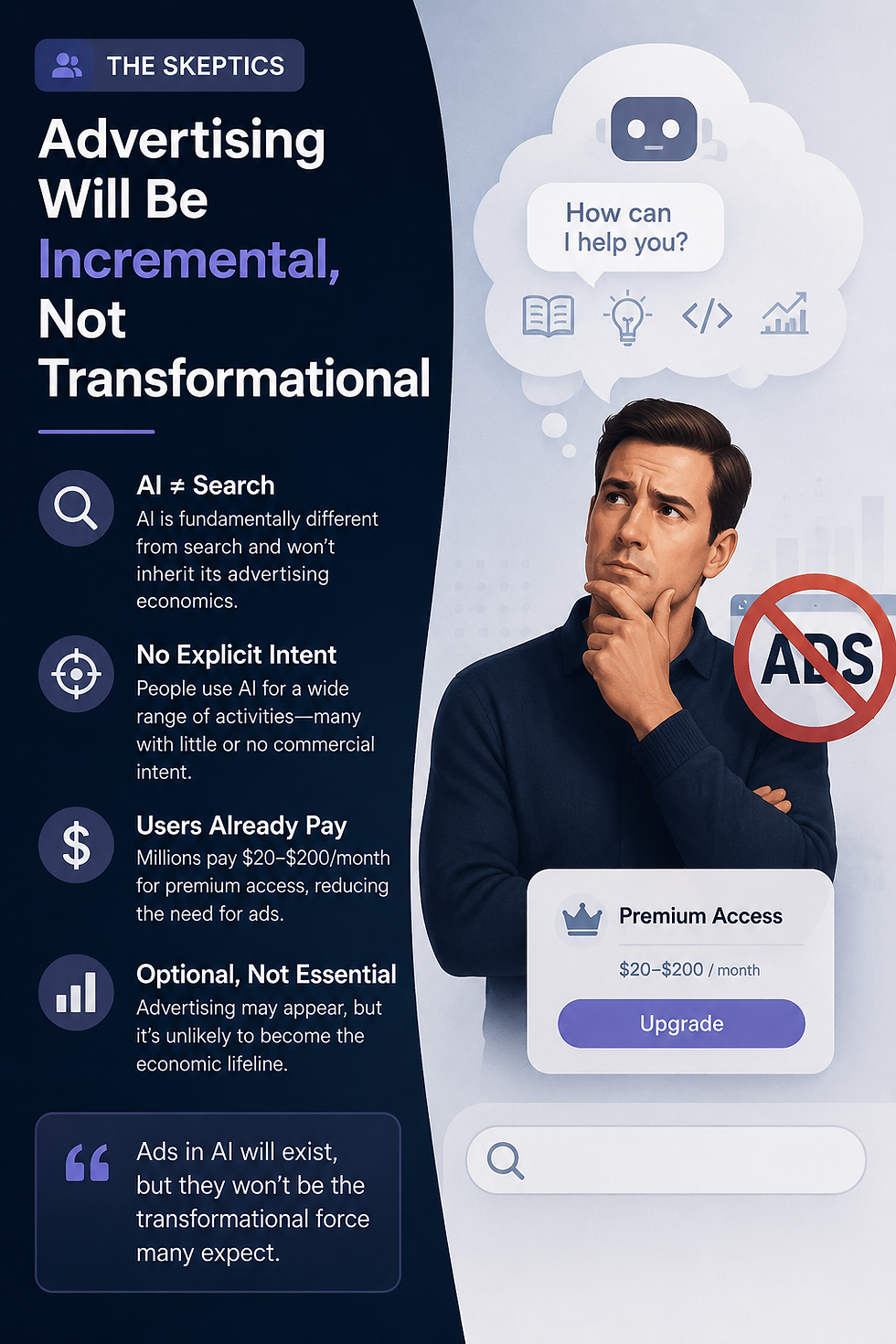
The first group consists of skeptics who believe advertising in AI will be far less significant than many expect. Friend of S&N Podcast Erez Levin has been one of the most thoughtful and articulate voices in this camp. In a series of essays and interviews, he argues that many people are dramatically overestimating the economic importance of ads in conversational AI. His core point is straightforward: AI is fundamentally different from search, and it should not be assumed that it will inherit search’s advertising economics.
The skeptic argument deserves to be taken seriously. Search created one of the most profitable business models in history because it captured explicit commercial intent at extraordinary scale. Billions of users typed short, transactional queries into a free product, and Google monetized those moments with highly relevant ads. The Google Search business is a monster—some call it the greatest business in world history—because Google generates between $3 and $3.50 per user per month. Monetized across 14 billion searches per day, it's a cash-generating machine.
Conversational AI is different. People use tools like ChatGPT for a much broader set of activities, many of which have little or no commercial intent. Skeptics also point out that frontier AI companies already have something Google never had in the early days of search: meaningful direct revenue from users. Millions of people are paying OpenAI, Anthropic, and Google Gemini between $20 and $200 per month for premium access. When customers are already paying this much, advertising becomes less of a necessity and more of an optional enhancement. From this perspective, ads may appear, but they are unlikely to become the economic lifeline many assume.
The Optimists: AI Will Become the Next Great Advertising Platform

The second group is made up of optimists who believe AI could evolve into one of the largest advertising platforms in history. Their argument is based on a simple but powerful idea: whoever intermediates consumer decisions will eventually monetize those decisions. If AI assistants become the default way people research products, plan trips, choose doctors, compare financial products, and make purchases, they will sit directly in the flow of high-value commercial intent. It's frankly difficult to refute this hypothsis.
This is where the upside becomes enormous. Search monetized keywords. AI has the potential to monetize decisions. Instead of showing ten blue links and a handful of sponsored results, AI systems can synthesize options, make recommendations, and increasingly take action on a user’s behalf. This creates a much more influential role in the purchase journey and, potentially, a much more valuable one.
The Optimist school of thought sees AI advertising as the Next Big Thing, potentially supplanting traditional Search as the greatest business in world history. One report predicted the category will explode to $25.93 billion by 2029, representing 13.6% of overall search ad spending.
The Purists: Advertising Risks Corrupting Trust

The third group consists of fierce critics who are less focused on economics and more concerned about trust. Their concern is that advertising could distort the outputs of AI systems in ways that are difficult for users to detect. If a model is simultaneously acting as advisor, researcher, and decision-making assistant, any commercial influence raises fundamental questions about objectivity and transparency.
These concerns could be legitimate. In many ways, the value of AI depends heavily on the perception that the system is acting in the user’s best interest. Entering advertising could potentially corrupt the results. Once sponsored recommendations are introduced, platforms will need to demonstrate that monetization does not compromise credibility. In many ways, this may be the most important issue in the entire debate.
Capitalizing on these concerns, Anthropic made its Super Bowl debut with a humorous "anti-advertising" advertising campaign for Claude, skewering rival OpenAI's decision to bring sponsored ads to ChatGPT. The ads featured the tagline "Ads are coming to AI. But not to Claude." AdWeek reported an 11% spike in Claude's daily active users following the campaign.
If you ask me, all three schools of thought raise valid points. The skeptics are right that AI does not need advertising in the same way search once did. The optimists are right that controlling decision-making creates extraordinary monetization opportunities. And, yes, the critics are right that trust is the asset that matters most. The future of advertising in AI will be determined by how these three forces ultimately balance.
My View: Advertising Is Incremental, Not Existential
My own view sits somewhere between the skeptics and the optimists. I 100% believe advertising will become a significant revenue stream for consumer AI platforms. Over time, it certainly could grow into one of the most important new channels in digital marketing. But I do not believe advertising is essential to the economic survival of frontier AI companies, which changes things. Unlike Google in the early days of search, these businesses are already generating extraordinary revenue from subscriptions and enterprise licensing.
Keep in mind, the most important variable in the debate over advertising in AI is average revenue per user, or ARPU. When you compare the economics of Google Search with those of frontier AI platforms, the difference is striking. Google built one of the most successful businesses in history by monetizing a free product almost entirely through advertising. Frontier AI companies are already generating substantial revenue directly from consumers and enterprises before showing a single ad.
That distinction really matters. Google monetized attention as it turned billions of free searches into advertising revenue, making ads the foundation of its business model. By contrast, OpenAI, Anthropic, and Google Gemini are charging consumers and businesses anywhere from $20 to $200 per month for premium access, while simultaneously building large enterprise businesses around APIs and commercial subscriptions. This is an unprecedented economic model in technology. Google had to monetize search aggressively because the product was free. Frontier AI companies are already monetizing utility directly. OpenAI's annualized revenue run rate (ARR) is approximately $25 billion, driven heavily by subscriptions and enterprise usage of ChatGPT. This translates to roughly $2 billion in monthly revenue.
From this perspective, advertising should be viewed as incremental rather than existential. Assuming advertising takes off, which I believe will be the case, it has the potential to add billions of dollars in high-margin revenue, subsidize free tiers, and create entirely new forms of commerce and performance marketing. But consider that these companies do not need advertising to justify their valuations or sustain their growth. Ads are an opportunity to make already powerful business models even more profitable.

It is also important to recognize how early we are in a transition period when it comes to advertising. While many people talk about “ads in AI” as though the format is obvious, the reality is that no one yet knows what the dominant advertising models will look like. Some implementations may resemble familiar display units, with clearly separated sponsored placements appearing alongside responses. Others may be far more conversational, with the AI guiding users through options and disclosing when certain recommendations are sponsored.
The most likely outcome is that entirely new advertising formats will emerge. Search ads are not simply banner ads placed on a search page—they were purpose-built for intent-driven interactions. AI will almost certainly produce its own native commercial formats, designed specifically for conversational and agentic experiences. The eventual winners will be the companies that discover how to integrate monetization in ways that feel useful rather than intrusive.
That uncertainty is exactly why the debate remains so active. We know advertising is coming, but we do not yet know what forms users will ultimately accept, what formats will perform best, or how regulators will respond. What seems clear, however, is that advertising will become an important additional layer of monetization. It just does not need to carry the entire economic weight of the industry the way it once did for Google Search.
Advertising Models Likely to Emerge
One of the most important things to understand is that advertising in AI will probably not recreate the formats that dominated search and social. Search introduced sponsored listings tied to keywords. Social embedded ads into content feeds. AI is likely to produce entirely new commercial models designed specifically for conversational interfaces and, eventually, autonomous agents.
The most immediate format is sponsored recommendations. A user might ask for the best laptops under $1,500 and receive a curated list of options, with clear disclosure that one or more recommendations are sponsored. This is the natural evolution of paid search, but potentially far more powerful because the AI is not merely presenting links. Rather it is synthesizing information, comparing trade-offs, and actively helping the user make a decision.

A closely related model is conversational commerce. In this scenario, the AI does more than recommend products—it guides the user through the buying process and completes the transaction directly. Revenue could thus come from affiliate commissions, retailer partnerships, or simple transaction fees. In effect, the assistant becomes both advisor and storefront.
We are also likely to see pricing models shift from impressions and clicks toward outcomes. Rather than paying for exposure, advertisers may increasingly pay only when the AI drives a measurable result such as a purchase, hotel booking, insurance quote, or qualified lead. This cost-per-outcome approach aligns naturally with systems that are designed to influence and increasingly execute decisions. Granted, in this model tracking and attributing actual conversions becomes not only a technical challenge but potentially a point of contention. But let's assume the platforms find a way.
The most ambitious vision is what some are calling "agentic commerce," in which AI agents transact and negotiate on behalf of users. This idea has sparked a fierce debate across the industry. Eric Seufert has argued relentlessly that much of the excitement around agentic commerce is a mirage, suggesting that the technical, behavioral, and economic barriers are far greater than many enthusiasts acknowledge.
I believe agentic commerce will happen, but it may look very different from the more futuristic scenarios often described. Rather than fully autonomous agents independently shopping across the internet, the near-term reality is more likely to involve structured recommendation systems, tightly integrated retail partnerships, and gradual increases in automation. The concept is real, but the path to adoption will almost certainly be more incremental and constrained than some expect.
Over time, however, machine-to-machine negotiation could become increasingly important. Buy-side agents acting on behalf of consumers or advertisers may interact directly with sell-side agents representing retailers, publishers, and service providers. Frameworks such as Ad Context Protocol, or AdCP, point toward a future in which advertisers submit structured offers containing pricing, availability, incentives, and guarantees, and AI systems evaluate those offers in real time to determine the best option for the user.
The common thread across all of these models is that advertising becomes more integrated into decision-making and execution. Instead of interrupting users with generic messages, commercial opportunities are embedded directly into recommendations, transactions, and automated workflows. This shift has the potential to make advertising in AI more contextual, more measurable, and ultimately more valuable than the formats that came before it.
The UX Challenge: Ads Without Destroying Trust
When you think about it, the most important issue in the entire debate may have nothing to do with revenue. We're talking about trust. For many of us, AI assistants are rapidly becoming research tools, advisors, and decision-making partners. As users increasingly rely on systems like ChatGPT, Claude, and Gemini to evaluate products, summarize information, and make important choices, the credibility of the recommendation engine becomes the core asset.
This creates a fundamental design challenge: how do you monetize recommendations without undermining confidence that the system is acting in the user’s best interest? Traditional digital advertising has long operated on the assumption that users understand commercial messages are mixed with editorial content. In AI, the stakes are much higher. The assistant is not simply presenting information; it is interpreting, prioritizing, and often making recommendations that users may follow with little additional research.

If users begin to suspect that recommendations are being shaped primarily by commercial incentives, trust can erode quickly. And without trust, the entire value proposition of the platform weakens. This is why the purists are raising an essential warning. Advertising may represent a significant revenue opportunity, but it cannot come at the expense of the objectivity and usefulness that make these systems valuable in the first place.
The good news is that this problem is solvable, provided platforms approach monetization (and ads) thoughtfully. Sponsored recommendations should thus be clearly disclosed. Users should be able to control the extent to which commercial content appears in their experience, and preference-based personalization can ensure that sponsored options are genuinely relevant. Platforms will ultimately need to provide transparent explanations of why certain recommendations were ranked or selected.
In many ways, AI platforms face a challenge similar to the one that search engines confronted two decades ago, but with much greater stakes. Google succeeded because it managed to integrate advertising while preserving enough trust that users continued to rely on its results. AI companies will need to achieve the same balance, but in a much more intimate and influential interface.
This is why trust is likely to become the defining constraint on advertising in AI. The companies that succeed will not be the ones that insert the most ads. The winners will be the ones that design commercial experiences that remain useful, transparent, and aligned fiercly with the interests of the user. If they get this right, advertising will become a powerful and accepted part of the AI economy. If they get it wrong, they risk undermining the very foundation on which these platforms are built.
Conclusion: Advertising Is Coming, But It Doesn’t Need to Carry the Business
So where does all of this leave us? In my view, advertising will almost certainly become a major revenue stream for AI platforms. The opportunity is simply too large to ignore. If AI assistants increasingly shape how people research products, compare options, and make purchasing decisions, commercial monetization will certainly follow.

But unlike Google in the early days of search, frontier AI companies are not forced to depend on advertising to survive. OpenAI, Anthropic, and Google Gemini are already generating extraordinary revenue through subscriptions, enterprise contracts, and APIs. They have achieved something Google did not have at the outset: users and businesses are paying directly for the utility these systems provide.
This fundamentally changes the economics in a fundamental way. Advertising in AI is important not because these companies need it to justify their business models, but because it represents an extraordinarily attractive incremental layer of monetization. Even modest advertising revenue, when added to already exceptional ARPU, can translate into billions of dollars in additional high-margin income.
At the same time, it is still very early. The winning ad formats have not yet been fully defined. The dominant commercial models may look like sponsored recommendations, conversational commerce, cost-per-outcome pricing, or some entirely new construct that has not yet emerged. We know monetization is coming, but the exact form it takes remains unsettled.
And that brings us back to the issue that matters most: trust. The real question is no longer whether ads will appear in AI. It is whether the industry can introduce monetization in a way that preserves the credibility of the recommendation engine itself. If platforms get that balance right, advertising could become one of the most significant new revenue opportunities in technology. If they get it wrong, they risk undermining the very foundation on which the AI economy is being built.
----------------------

Rio is an executive with 20+ years at the intersection of strategy consulting, AdTech, data, and media. He's a trusted advisor on customer experience, digital strategy, and marketing transformation. He's a partner at Credera, Omnicom's consulting arm. He's also a podcast host, writer, and public speaker focused on the future of advertising and AI-driven infrastructure.


Comments