
Agentic Aftermath: Who Wins (and Loses) When Media Becomes Negotiated

As media buying moves from auctions to negotiation, control shifts upstream — and the entire ecosystem feels it.
AdCP introduced a new coordination layer for advertising — but the real story is what it breaks. As agents move media buying upstream from auctions to negotiation, DSPs, SSPs, publishers, and agencies all face structural disruption. This isn’t about better automation — although that is going to happen too. It’s about control of allocation, and a reshuffling of power across the ecosystem that results.
We Built the System Around Auctions. That’s About to Change.
In the last piece, I laid out the case for AdCP — not as another acronym in an already AdTech crowded ecosystem, but as something more foundational. I described it as an evolving coordination layer that enables agents to communicate intent, constraints, and outcomes across platforms, connecting buy-side and sell-side in a future negotiated marketplace.
That piece was about what is changing. This one is about what that change actually does — because the industry’s instinct is to treat this transition like every other innovation hype cycle. New capability means new features, which require new integrations, and definitely new tools. Maybe it makes things faster, or improves performance at the margins.
But this framing misses the point. Adoption of AdCP is not just about enabling better execution. Taken to its logical conclusion — even if this is a few years out — it changes where decisions happen, and how they happen. And when you change where decisions happen, you change who controls the system.
Consider that for the last 15+ years, digital advertising has been built on a simple assumption: the most efficient way to coordinate supply and demand is through auctions. Everything — from DSPs to SSPs to measurement — has been designed around the premise. that Real-Time Bidding, or RTB, wasn’t just a mechanism. It became the foundation of the market.
AdCP — and the rise of agentic trading in media — does not replace that foundation overnight. But it does start to shift the center of gravity away from it. From reactive bidding to proactive decisioning, from impression-level execution to system-level coordination, and from humans operating tools to agents operating markets.
My argument is once this shift starts, the implications are not incremental. They are structural. So before we get lost in protocol specs or early use cases, it is worth asking the more important question: What happens to the ecosystem when the auction is no longer the primary coordination mechanism?
Allocation Moves First — and Everything Else Follows
At its core, this shift is not about AI, or protocols, or even automation. It is about allocation — specifically, where allocation actually gets decided. Sure, we already allocate at a strategic level. Marketing Mix Modeling (MMM), planning cycles, and budget frameworks determine how spend should be distributed across channels and partners. But this operates at a high level and on slower time horizons. It does not determine how that allocation translates into actual media outcomes. That happens downstream.
In today’s model, Real-Time Bidding is where allocation becomes real. It determines which impressions are bought, where they run, and at what price — one decision at a time, based on the signals available in that moment. Each bid is a micro-decision, and over time, those decisions shape how budget is actually deployed in market. So while we plan allocation upfront, we still discover it through execution. I would argue this is the gap.
And this is the layer that agentic systems — and by extension AdCP — begin to close. Today’s system backs into allocation through execution. That worked when the problem that needed solving was speed and scale. But it falters when the problem becomes coordination. Bidding is inherently downstream — it reacts to opportunities that have already been defined, constrained by available inventory, packaging, and signals.
Agentic systems invert this model. Allocation becomes explicit, because systems can evaluate objectives, constraints, and trade-offs upfront, determine how budget should be distributed, and then coordinate directly with the market to execute against that plan. Instead of execution driving allocation, allocation is translated into negotiated outcomes and then executed.
Put simply, we are moving from bidding on outcomes… to deciding outcomes upfront. And once allocation moves upstream, execution does not disappear — but it stops being the center of gravity.
The Implications: This Is Where the Market Breaks
If the previous sections are about what is changing, this is about what changes in the current system once allocation moves upstream — once decisions are made before execution instead of through it — and the entire ecosystem built around RTB starts to lose its center of gravity.
It’s also important to point out that these changes do not happen all at once, and not evenly. But they are inevitable, in my opinion. What follows is how this shift may actually play out across the ecosystem.
Because once the center of gravity moves, every player has to be re-evaluated against a single question: where do they sit relative to allocation — and what happens if they don’t control it?
We’ll start with Demand Side Platforms, or DSPs, where the impact is the most immediate — and most misunderstood.
DSPs: From Decision Engines to Dumb Pipes
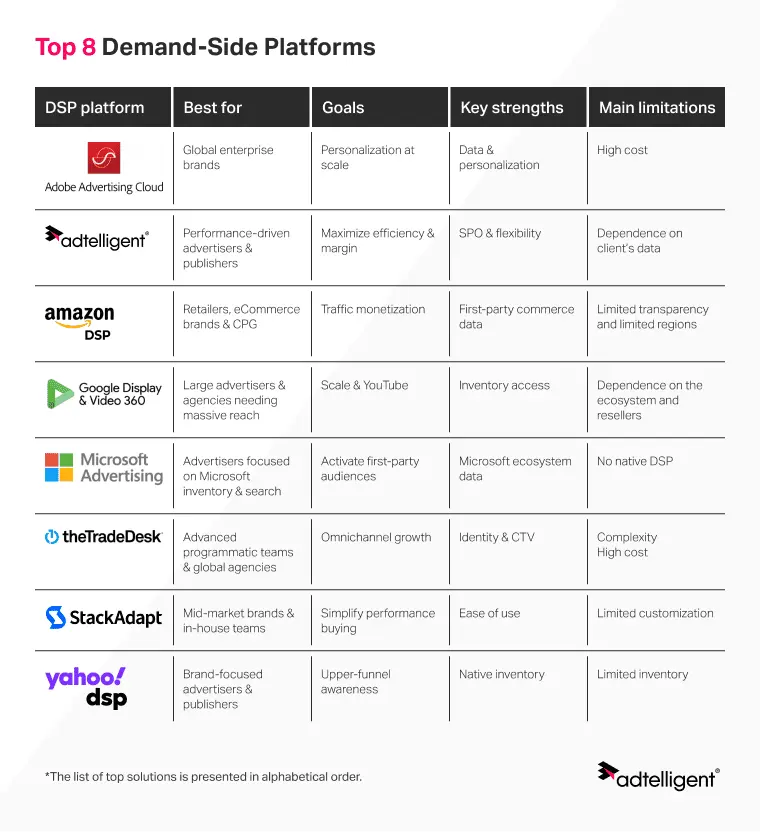
For years, DSPs have positioned themselves as the brains of the operation. They ingest signals, run bidding logic, optimize toward outcomes, and ultimately decide where spend goes. But if allocation decisions are made before a bid is ever placed, that role starts to shrink.
In an agentic model, the “decision” is no longer happening inside the DSP — unless DSPs evolve significantly. Instead, it happens upstream within the agent layer that define objectives, constraints, and budget distribution. The DSP thus becomes the mechanism through which those decisions are executed, not the place where they are made.
This is a meaningful downgrade. DSPs do not disappear, but their leverage changes. They begin to look less like decision engines and more like access layers to supply — pipes that connect demand to inventory. Dumb pipes if we’re not being nice.
Because they will do less, it becomes much easier to create a DSP, though harder to make money with one. Moreover, if you’re a DSP in this world without exclusive to O&O inventory, differentiation gets a lot harder, because if you do not control allocation, you do not control the budget. This is why I would go long on Amazon DSP but short on The Trade Desk.
SSPs and Exchanges: The Supply Chain Gets Shorter
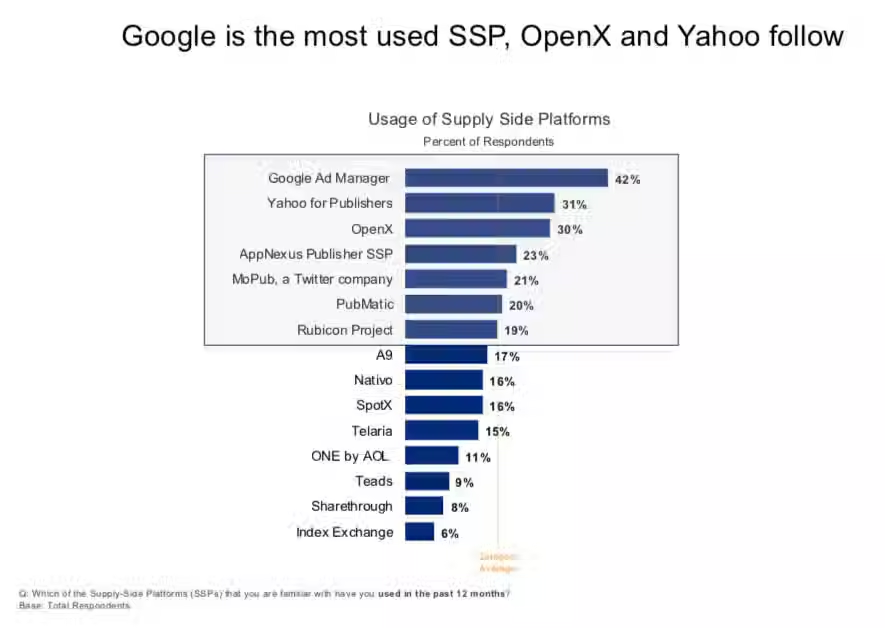
The current programmatic supply chain is long, complex, and full of intermediaries. SSPs and exchanges — and the resellers layered on top of them — each add a layer of routing, packaging, and monetization. In many cases, the same piece of inventory is passed through multiple paths, re-labeled and re-sold along the way, adding hops, increasing fees, and muddying the waters for both advertisers and publishers trying to understand what they are buying or selling.
This Byzantine structure exists because coordination has historically been hard. Agentic systems offer potential to change this. When buyers and sellers can communicate intent and negotiate directly — when they can negotiate outcomes instead of relying on auctions to approximate them — the need for multi-hop routing starts to diminish.
The result is fewer hops with fewer fees and less opaque layers. This does not mean SSPs disappear, but it does mean that the part of the ecosystem built on fragmentation and opacity becomes increasingly difficult to justify in its current form. The supply chain compresses, and when it compresses, the long tail of intermediaries gets squeezed. The number of SSPs probably gets compressed considerably, with the impact being felt most prominently by those who act primarily as resellers.

Publishers: A Window to Reclaim Control
For publishers, this shift cuts both ways. On one hand, agentic coordination offers something they have not had in a long time: a direct line to demand that is not filtered entirely through auctions or intermediaries. This opens up the ability to package inventory dynamically, express constraints, and negotiate outcomes tied to real business objectives — not just CPMs.
For publishers with premium inventory, this is a golden opportunity, and in theory, a path out of the wilderness and back to pricing power. But this is not guaranteed, because the same systems that enable direct negotiation will also create new interfaces. If publishers do not actively participate in those interfaces — if they do not expose their inventory, data, and constraints in ways agents can understand — they risk being abstracted away again, just at a different layer.
AdCP does not necessarily save publishers, but it gives them a shot, which is better than what they have now, I would argue.
Retail Media and Walled Gardens: Already Operating Upstream
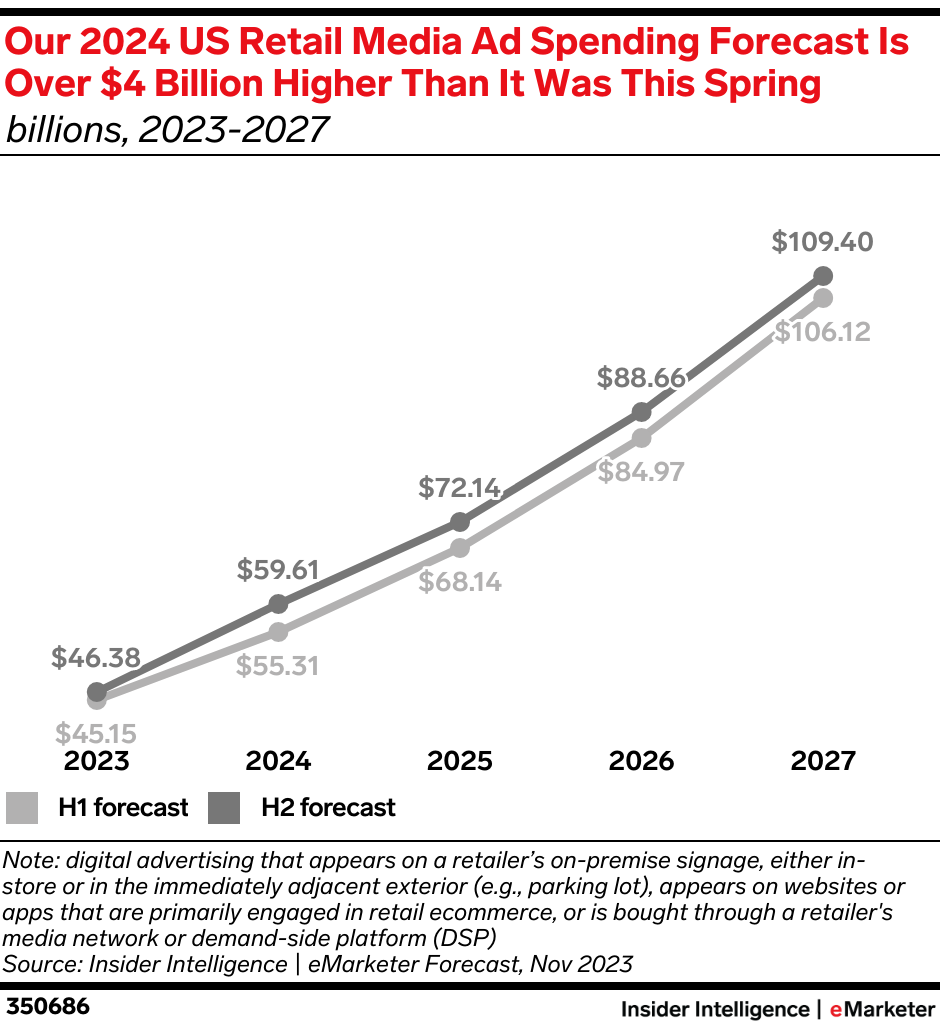
While I realize this future may feel somewhat abstract, consider that parts of this ecosystem are already there, hiding in plain sight. Retail Media Networks and Walled Gardens have been operating closer to allocation for years. They control supply, have deterministic data, and offer integrated environments where planning, activation, and measurement are tightly coupled.
They do not rely on open auctions in the same way I am describing here, but they operate upstream, even if they do not necessarily describe it that way. This is why they are gaining share. What looks like innovation in retail media is, in many ways, just convergence toward this new model. Controlled environments, direct coordination, and outcome-based thinking. They are not the exception. If anything, they are a preview.
Agencies and HoldCos: From Campaign Execution to System Orchestration
This is where the shift becomes existential. For decades, agencies have created value through planning, buying, and optimizing media. Even as tools evolved, the core model remained intact: humans operating platforms to execute campaigns, supported by the FTE billing model.
Agentic systems challenge this model directly. If machines are making allocation decisions — if they are negotiating, optimizing, and executing continuously — then the role of the agency cannot be to operate the system. It must design and govern the operating system itself.
That means defining objectives, setting constraints, and determining how agents behave, what data they use, and how outcomes are measured. There will be fewer decisions, but far more important ones, and the winners will be the organizations that build operating systems for media — systems that connect data, decisioning, and execution into a coherent whole. The losers will be those who remain focused on optimizing within platforms they do not control.
The next agency does not just buy media. It also governs machines that do. For those who missed it, I wrote about this shift a couple weeks ago on Signal & Noise in the "From HoldCos to Operating Systems" article.
Measurement: The Collapse of Impression-Level Thinking
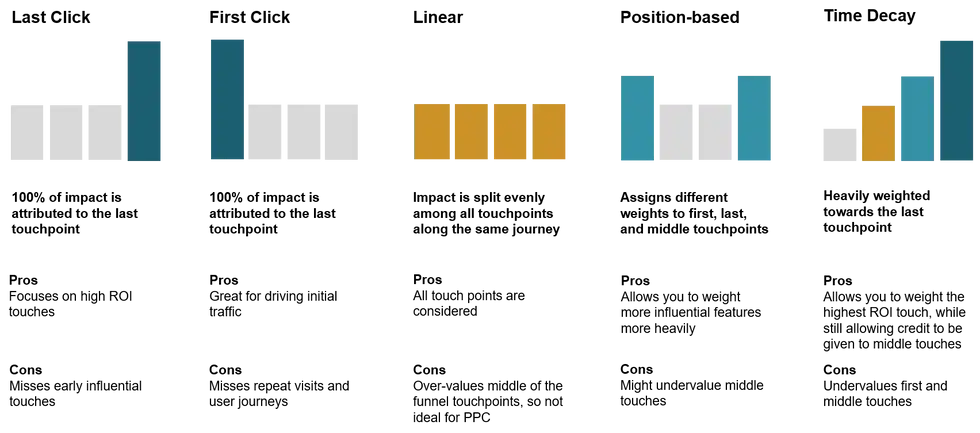
Measurement has always followed execution. In a world defined by impressions and auctions, we built attribution models that tried to assign credit at the impression level. First touch, last touch, multi-touch, probabilistic modeling — all attempts to make sense of fragmented, downstream signals.
But if allocation decisions are made upfront, that framework starts to break down, because the unit of decision is no longer the impression. It is the portfolio in which agents are optimizing across time, channels, and constraints simultaneously. This is because they will be making trade-offs that cannot be understood by looking at a single touchpoint in isolation.
This forces a profound shift from attribution to incrementality, from channel performance to system performance, and from measuring activity to measuring outcomes. Let’s be honest, most organizations are not ready for this, especially agencies.
Data: From Asset to Input
For years, the industry has treated data as the primary source of competitive advantage. Own the data, control the outcome, so the logic goes. But this argument begins to crumble in an agentic world, because data on its own does not make decisions. Agents do.
The value of data shifts from ownership to usability, from being a static asset to being a dynamic input into decisioning systems. What matters is not just what data you have, but whether your systems can access it, interpret it, and act on it in real time.
Interoperability starts to matter more than exclusivity. In this paradigm, companies that win will not necessarily be the ones with the most data — but the ones whose agents can use it most effectively to drive demonstrable outcomes.
This is the part of the story most people are underestimating. Not the protocol or the technology, but the fact that when allocation moves, everything built around it has to move too. This creates a clear inversion of how the system operates today.
Instead of execution driving optimization and optimization eventually shaping allocation, allocation is defined first. That allocation is then translated into negotiated outcomes, and execution follows as a downstream function. Once allocation moves upstream, the rest of the system loses its position as the primary control point. The locus of decision-making shifts, and with it, the balance of power.
What This Means Now — and Where This Is Heading
If you zoom out, this is not just another cycle of tooling innovation. It is the continuation of a set of shifts that have been building for years — and that I have written about repeatedly on Signal & Noise.
In The UX Reckoning Part II: From Interfaces to Intent, the argument was that interfaces are losing their central role as the primary way humans interact with systems. In From HoldCos to Operating Systems, the thesis was that agencies are no longer competing on execution — they are competing on the systems they build to orchestrate it. And in the AdCP piece, the focus was on the emergence of a shared coordination layer for machines.
This is where those threads converge. Because what agentic trading ultimately does is force a redefinition of where value sits in the system. It is no longer in the interface or the workflow. Increasingly, it is not even in the execution layer. It will be in allocation. That has very real implications for how operators need to respond.
The first is a shift in mindset. Most organizations are still structured around managing tactics — channels, campaigns, platforms. This model assumes that decisions are made continuously, inside execution. In an agentic world, the number of decisions decreases, but their importance increases, and the focus shifts to defining objectives, constraints, and guardrails that shape how the system behaves over time.
The second is a shift in investment. For years, companies have invested heavily in activation layers — DSPs, SSPs, campaign management tools — because this is where control appeared to sit. But if allocation is moving upstream, then control moves with it. This puts pressure on organizations to invest in data foundations, decisioning layers, and interoperable systems that can actually inform and govern agents, not just execute against their outputs.
The third is a shift in how we think about differentiation. Owning data, optimizing bids, building custom workflows — these have all been sources of advantage in the current model. They matter less in a world where agents are coordinating directly and continuously. Advantage shifts to those who can design better systems: systems that integrate data cleanly, express intent clearly, and adapt dynamically over time.
This is why the “operating system” framing matters more now than ever. Because what is emerging is not just a more automated version of programmatic. It is a system-level rearchitecture of how media is planned, bought, and measured, and the organizations that win will be the ones that treat it that way — not as a feature or a capability, but as an operating model.
That is also why this shift will not happen suddenly, but will take place faster than most expect. Not because the technology is perfect today. It is not. But because the current system is already under strain. Signal loss, platform consolidation, cost pressure, and organizational complexity have pushed the model to its limits. Adding more optimization on top does not solve and of these longstanding issues. Moving the decisioning layer does.
Once the center of gravity starts to move, it will be very hard to reverse. So what I’m proposing is not the next phase of programmatic. It is not smarter bidding or better automation. Nor is it a new protocol story. It is a fundamental power shift — a shift in where decisions are made and in who controls allocation. It’s ultimately a shift in how the market itself operates. The companies that win will not be the ones that bid better. They will be the ones that decide earlier.
----------------------

Rio is an executive with 20+ years at the intersection of strategy consulting, AdTech, data, and media. He's a trusted advisor on customer experience, digital strategy, and marketing transformation. He's a partner at Credera, Omnicom's consulting arm. He's also a podcast host, writer, and public speaker focused on the future of advertising and AI-driven infrastructure.


Comments