
The Peculiar Rise of the Marketing Engineer: How AI Is Redesigning the Marketing Profession
Updated: Aug 6

Every Technology Revolution Creates a New Kind of Marketer
The rise of television transformed advertising from a largely print-based discipline into one centered on broadcast media, giving rise to media planners and television specialists. The internet ushered in the era of the digital marketer. Search engines created SEO specialists, and social media produced community managers and social strategists. As customer data exploded and marketing became increasingly software-driven, organizations introduced the marketing technologist, a role dedicated to connecting platforms, managing increasingly complex MarTech stacks, and helping marketing organizations turn technology into competitive advantage. Scott Brinker, AKA the Godfather of MarTech, has argued for years that marketing is becoming as much a technology discipline as a creative one, and the rapid growth of the marketing technology landscape reflects this transformation.
Artificial Intelligence represents the next chapter in this evolution. But unlike previous technology waves, AI isn’t simply introducing another marketing channel or another software platform. In many ways, it is fundamentally changing how marketing work gets done.
For the past twenty years, technology primarily helped marketers execute faster. CRM platforms organized customer information, Marketing Automation platforms streamlined campaigns, CDPs unified data, and analytics platforms helped measure performance. Each innovation improved the efficiency of human marketers while leaving the basic structure of marketing work largely intact.
I would argue AI is different. Instead of merely helping marketers execute tasks, AI is increasingly capable of performing many of those tasks itself. For example, it can generate creative assets, analyze audiences, write copy, build dashboards, summarize research, optimize campaigns, create code, and increasingly coordinate entire workflows through autonomous agents. The question facing marketing organizations is no longer, “How do we use AI?” It is rapidly becoming, “How should marketing work be organized, and how should marketing teams be structured, when AI performs much of the execution?”
Every major technological revolution creates a new profession. AI won’t be any different.
This distinction matters because AI transformation is often misunderstood as a technology initiative. In reality, it is an organizational design challenge. Over the past year, management researchers and industry analysts have increasingly converged on this point. Bain & Company has found that organizations pursuing AI initiatives frequently underestimate the organizational changes required to capture value from the technology. MIT Technology Review has similarly argued that the rise of agentic AI requires companies to rethink organizational design itself, not simply adopt new software. The Drum has gone even further, suggesting that many AI enablement efforts fail because they expose underlying organizational design problems that existed long before AI arrived.
In other words, AI isn’t just changing what marketers do. It is fundamentally changing how marketing organizations are structured, how work flows across teams, and what capabilities companies need to develop internally. This is why I believe we’re witnessing the emergence of a new professional archetype: the Marketing Engineer. This isn’t simply another job title to add to LinkedIn. Nor is it merely a rebranding of marketing operations or marketing technology. The Marketing Engineer represents a fundamentally different way of thinking about marketing work.
Traditional marketers create campaigns, while marketing technologists build and manage the technology stack that enables those campaigns. Marketing Engineers design the intelligent systems that increasingly create, optimize, coordinate, and improve marketing itself. This distinction may sound subtle today, but within a few years, I suspect it will seem obvious.
This role has already begun appearing across startups, AI-native companies, and forward-thinking enterprise organizations. Publications including GrowthOS, Profound, MarketVeep, Uplifted AI, and others have begun describing the Marketing Engineer as an emerging hybrid professional who combines marketing strategy, automation, data, AI, and technical implementation into a single role. While the exact definition varies, they all point toward the same conclusion: the boundaries that once separated marketers, technologists, analysts, and automation specialists are beginning to dissolve.

But I would argue the Marketing Engineer is more than a new hybrid role. It is the first visible sign of something much larger. For more than two decades, marketing organizations have been structured around human execution. Specialists owned channels, teams owned platforms, and campaigns moved methodically from one department to another through carefully designed handoffs.
Generative AI isn’t just automating marketing tasks. It’s collapsing the traditional boundary between the people who build marketing systems and the people who use them.
AI changes these economics. When intelligent systems can perform significant portions of execution, competitive advantage shifts away from performing individual tasks and toward designing the systems that perform those tasks. The scarce resource is no longer execution capacity—it's systems thinking.
That is why I believe the Marketing Engineer is not simply a fluffed up version of the Marketing Technologist. It represents the next stage in the evolution of the marketing profession itself.
To understand why this role has emerged—and why I believe it will become one of the defining marketing careers of the AI era—we first need to understand how marketing has evolved over the past twenty-five years.or technological shift leaves behind more than new tools. It creates entirely new professions.
Marketing Has Been Evolving for Decades. AI Is Simply the Biggest Leap Yet.
The emergence of the Marketing Engineer didn’t happen overnight. In many ways, it represents the latest chapter in a transformation that has been unfolding for more than two decades. Like it or not, marketing has always evolved alongside technology. What changes from one era to the next isn’t simply the tools marketers use, it’s the capabilities organizations expect marketers to possess.
For much of the twentieth century, marketing was primarily a discipline of creativity, communications, and media. Success thus depended on understanding customers, developing compelling brand narratives, crafting memorable campaigns, and buying media effectively. Technology certainly existed, but it largely remained behind the scenes or at the margins. Agencies, creative talent, and media expertise defined competitive advantage.
Then rise of the internet changed everything. Digital marketing introduced entirely new channels—search, display advertising, email, websites, mobile, social media, ecommerce, and eventually connected television (CTV). Suddenly, marketers weren’t simply creating campaigns, they were managing increasingly complex digital ecosystems. As a result, a plethora of new specialties emerged almost overnight. Emerging roles like SEO specialists optimized search rankings, paid search managers mastered bidding algorithms, email marketers became experts in customer journeys, and social media managers built communities across an expanding universe of platforms.
“More than 80% of business leaders expect AI to fundamentally reshape how work is organized within the decade.”
Source: Microsoft Work Trend Index
As marketing became more measurable, it also became significantly more technical. CRM systems, Marketing Automation platforms, web analytics, CDPs, Tag Management systems, Identity Resolution, Attribution tools, and AdTech all became essential parts of the modern marketing stack. According to Scott Brinker’s annual Martech Landscape, what began as a relatively modest collection of marketing software grew into an ecosystem of more than 15,000 products by 2025—a remarkable reflection of how deeply technology had become embedded in the marketing function.
The result wasn’t simply more software, but a new kind of marketer. Organizations increasingly found themselves hiring professionals who understood APIs, data models, integrations, analytics, automation platforms, customer identity, and marketing operations alongside traditional marketing disciplines. The title “Marketing Technologist” emerged to describe professionals capable of bridging the gap between marketing strategy and technology implementation. As Brinker observed years ago, these professionals became translators between creative teams, IT organizations, analytics groups, and business leaders—ensuring that increasingly sophisticated technology investments actually delivered business value.

In retrospect, the rise of the Marketing Technologist made perfect sense. Marketing became dependent on software, so someone needed to connect the platforms, govern the data, manage integrations, configure automation, and ensure that campaigns actually functioned as intended. The Marketing Technologist became the architect of the marketing stack.
For nearly a decade, that role represented the cutting edge of modern marketing. Today, however, we’re entering another inflection point. The challenges facing marketers are no longer simply managing technology because, increasingly, the technology is managing itself.
AI copilots can generate campaign copy in seconds, while image and video models dramatically reduce production timelines. LLMs can summarize research, analyze competitors, write SQL, generate code, and recommend optimizations, and AI agents are beginning to orchestrate workflows across CRM platforms, analytics tools, customer data platforms, advertising systems, and creative applications with minimal human intervention.
This represents something fundamentally different from previous waves of marketing technology. Looking back over the past 10 years, CRM systems didn’t decide which customers to target, nor did marketing automation platforms write messaging. CDPs couldn't be relied upon to create the formulas to determine the next best action, and analytics platforms didn’t recommend strategic decisions. Humans still performed all of these activities, even if they used technology to execute faster and with more precision.
AI increasingly participates in all of them, and this shift fundamentally changes what marketers are responsible for. While historically, marketers executed work using technology, tomorrow’s marketers will design the systems through which work gets executed. Think about it. This is actually a profound distinction. The value of a marketer is becoming less about operating individual tools and more about designing intelligent workflows, defining business rules, orchestrating AI agents, evaluating outputs, establishing governance, and continuously improving systems over time.
This is why I believe the Marketing Engineer is not merely the next evolution of the Marketing Technologist. This new role represents a transition from technology management to systems design.
And unlike previous technology transitions—which primarily introduced new tools—AI is reshaping the very nature of work itself. As organizations rethink operating models, redesign workflows, and redefine the relationship between humans and intelligent systems, marketing is becoming one of the first business functions to experience this transformation at scale.
At its core, the Marketing Engineer isn’t emerging because marketers suddenly need to learn more technology, but rather the role is emerging because marketing itself is becoming an engineering discipline—one focused less on executing individual campaigns and more on designing adaptive, intelligent systems that can continuously learn, optimize, and execute alongside human judgment.
The Four Eras of Modern Marketing
Era | Competitive Advantage | Defining Role |
Brand Era (Pre-1995) | Creativity & Storytelling | Brand Marketer |
Digital Era (1995-2012) | Channel Expertise | Digital Marketer |
MarTech Era (2012-2024) | Technology & Data | Marketing Technologist |
AI Era (2025-Present) | Systems Design & Orchestration | Marketing Engineer |
AI Isn’t Just (Yet) Another Marketing Technology. It’s More Like a New Kind of Coworker.
Every technology wave has promised to make marketers more productive, like a siren's song luring sailors lost at sea. CRM systems ostensibly made customer information easier to manage, marketing automation platforms sought to eliminate repetitive campaign tasks, CDPs came to market on the promise of seamlessly unifying fragmented customer data, numerous analytics platforms promised to make performance more measurable, and CMSs and DAMs were designed to simplify digital publishing.
Each of these innovations made marketing teams faster, more scalable, and more data-driven, but they all shared one defining characteristic: They required humans to remain firmly in control of the work.
Software organized information, but marketers made the decisions. This relationship has defined marketing technology for nearly three decades.
I posit that Artificial intelligence fundamentally changes this equation. Rather than simply organizing information or automating repetitive tasks, AI increasingly participates in the work itself. Consider this:
AI can research competitors, generate campaign ideas, write creative copy, produce images / video, analyze customer segments, identify optimization opportunities. It can even write SQL (or any code), build dashboards, summarize meetings, and recommend budget allocations.
For the first time in the history of marketing, MIT explains that organizations are deploying systems capable of performing work that previously required both human expertise and execution. This distinction really cannot be overstated. Previous technology waves increased the productivity of marketers, but AI increases the capability of the marketing organization itself.
This is why I often think of AI less as software and more as a new kind of coworker. Like any employee, AI can perform certain tasks exceptionally well, struggle with others, require oversight, improve through feedback, and collaborate with specialists across an organization. The difference, of course, is that this coworker can increasingly operate continuously, scale instantly, and participate in hundreds of workflows simultaneously, with no rest or respite.

The implications extend far beyond productivity. I would argue they fundamentally alter how marketing work should be designed. Think about it. For decades, marketing organizations have optimized around human skills or limitations. Teams have always been divided into specialists because no individual could master every discipline. Campaigns progressed through a sequence of handoffs because each step required a different expert or approval, and workflows were built around organizational boundaries, departmental ownership, and functional expertise.
AI dramatically reduces or eliminates many of those constraints. A single marketer can now accomplish work that previously required a copywriter, designer, analyst, researcher, automation specialist, and junior developer working together. While human expertise remains essential—particularly for strategy, judgment, creativity, and relationship building—the economics of execution have changed. The question is no longer: “Who should perform this task?” Increasingly, it becomes: “Should a human perform this task at all?”
The Marketing Engineer combines five disciplines: Marketing Strategy, Data & Technical Architecture, AI & Prompt Engineering, Workflow & Process Design, and Organizational Change.
This subtle shift changes pretty much everything. Instead of managing people performing individual activities, organizations must increasingly manage systems that coordinate work between humans and intelligent agents. The marketer’s responsibility thus evolves from executing discrete tasks to designing the environment (or system) in which those tasks are performed.
This is why I believe AI transformation is often misunderstood. Many organizations approach AI as a technology implementation project, so they evaluate models, purchase licenses, launch copilots, and experiment with isolated use cases—sound familiar? While these initiatives can certainly create value, they rarely transform the business on their own.
Based on what I'm seeing, organizations that are pulling ahead are simply asking different questions. They aren’t asking how AI can improve existing workflows. Instead, they’re asking whether those workflows should exist at all in their current form. Increasingly, the answer is no.
Tasks like campaign planning, audience creation, creative production, reporting, optimization, experimentation, quality assurance, and even elements of strategic planning are being redesigned around human-AI collaboration rather than sequential human execution. Sorry consultants, but this is not "digital transformation." It's "organizational transformation"—and organizational transformation inevitably creates new roles.
Just as the complexity of the MarTech era gave rise to the Marketing Technologist, the complexity of designing intelligent marketing systems is giving rise to the Marketing Engineer. No, this is not because marketers suddenly need to become software developers. This is because someone is needed to design the systems, workflows, governance models, evaluation processes, and collaboration patterns that allow humans and AI agents to work together effectively.
In other words, the future competitive advantage won’t belong to organizations that simply use AI.
Instead, it will belong to organizations that know how to engineer marketing around AI.
AI Transformation Is Really Org Transformation
For years, we’ve talked about digital transformation as though it were primarily a technology challenge, which is frankly why a lot of this work has failed to meet expectations." Initiatives filed under this "digital transformation" rubric might be implementing a new CRM, deploying a CDP, modernizing the MarTech stack, migrating solutions of datasets to the cloud, integrating databases, or even training employees on how to use new tools.
Across all these use cases, it's important top point out, technology is certainly the common denominator. But ask anyone who has spent time leading enterprise transformations, and they’ll tell you the same thing: The technology was rarely the hardest part. Most of the time, the real work is changing how people worked. One of the industry’s worst-kept secrets is that a significant portion of what consulting firms sell under the banner of “digital transformation” isn’t technology implementation at all. It’s change management, operating model redesign, governance, organizational alignment, and helping people adopt entirely new ways of working. The software can often be installed in months, but changing the organization can take years.
Artificial intelligence amplifies this reality. Organizations often begin their AI journey by asking familiar questions: Which model should we use? Should we buy Copilot or ChatGPT Enterprise? How should we govern prompts? Which use cases generate the fastest ROI? These are important questions, but they are not the questions that determine long-term competitive advantage.
The more important questions are organizational, according to McKinsey. Who owns AI? How should work be divided between humans and intelligent agents? Which decisions require human judgment? Which roles expand. and which roles disappear? What new capabilities need to be developed, and how should teams be structured when AI performs much of the execution? These questions don’t belong to the CIO alone, and probably require input from across the entire executive team, which is frankly what makes them so difficult to solve.
Increasingly, they involve the CMO. This is precisely the conclusion many researchers are beginning to reach. The MIT Technology Review argues that agentic AI requires organizations to rethink not just technology architectures but organizational architectures. Rather than simply embedding AI into existing workflows, organizations must redesign how work itself is coordinated across people, software, and increasingly autonomous agents.
Bain & Company reaches a similar conclusion with its research suggesting that organizations frequently underestimate the organizational redesign required to realize value from AI investments, focusing heavily on technology implementation while giving comparatively little attention to operating models, governance, incentives, and new ways of working. Deloitte's research reinforces exactly what Bain is saying: organizations underestimate the organizational and governance changes required for enterprise AI.
The piece referenced earlier by The Drum perhaps summarizes the challenge most directly, arguing that AI enablement doesn’t create organizational problems so much as expose the ones that already existed. Legacy processes, fragmented ownership, excessive handoffs, unclear decision rights, and siloed teams become dramatically more visible once organizations begin asking how AI should participate in their workflows. In other words, AI isn’t breaking organizations. It’s revealing where they were already broken.
Due to the way organizations have been historically structured and the nature of the work they do, marketing may be experiencing this shift faster than almost any other business function. Consider a typical enterprise marketing campaign. Strategy is developed by one team, audience segmentation is owned by another, creative is produced elsewhere (maybe by an agency), and media planning occurs separately. Operations teams then build workflows, analytics measures results. Furthermore, legal reviews content, compliance approves messaging, and performance teams optimize campaigns after launch. Sure, many of these handoffs have evolved for good reasons, but they reflected specialized expertise, organizational scale, and the practical realities of human capacity.
AI changes the economics of coordination. If intelligent agents can assist with research, generate creative concepts, build audiences, create assets, write code, perform quality assurance, monitor campaign performance, and recommend optimizations, the traditional sequence of departmental handoffs begins to look increasingly inefficient. If you'd like to read more about this trend, PwC’s research in the Jobs Barometer reinforced that jobs are evolving rather than disappearing.
What this means is organizations need to start asking fundamentally different questions. For example, do six teams still need to touch every campaign? Should approvals happen sequentially or simultaneously? Which decisions require people, and which can be delegated to AI? Should campaigns even be the primary unit of work, or should intelligent systems continuously optimize customer experiences without discrete campaign cycles at all?
The winners won’t build bigger marketing departments. They’ll build better marketing systems.
The issue here is these are not technology questions per se. They’re more like organization design questions. And anyone who has undergone some sort of organization design exercise can tell you, without hesitation, that org design always creates new roles. Someone has to redesign workflows, establish governance, and define how humans and AI collaborate. Looking at AI transformation of marketing, someone will also need to determine where judgment should remain human and where intelligent systems can safely operate independently—a responsibility that doesn’t neatly fit within traditional marketing operations.
Why is this? Because it isn’t owned exclusively by IT. Nor is it the responsibility of data science alone.
It sits at the intersection of marketing strategy, technology, process design, data, automation, governance, and AI. It's at this intersection where the Marketing Engineer role is beginning to emerge,
not because organizations need another technical specialist, but because they need someone capable of engineering an entirely new way for marketing to operate.

The Marketing Engineer: The First AI-Native Profession
For years, at least since the rise of "digital" in the late '90s, marketing has inexorably become more technical. The rise of email marketing, display, marketing automation, CDPs, identity resolution, experimentation platforms, and digital analytics has pushed marketers to become increasingly comfortable with technology. At the same time, engineers found themselves working more closely with marketers as customer experiences became technology-supported.
Yet despite this well-documented convergence, the two disciplines remain largely separate, both in org structure and ways of working. Marketers focus on strategy, customer experience, messaging, and growth. Working behind the scenes in IT, engineers build and support the systems that enable those activities, while marketing operations and analytics teams often act as translators (or marriage counselors) between the two. Artificial intelligence is collapsing these boundaries.
Modern AI systems don’t simply automate isolated marketing tasks. They can already write content, generate code, analyze customer behavior, build workflows, create audience segments, optimize campaigns, produce creative assets, synthesize research, and even coordinate work across multiple systems. Moreover, as these capabilities mature, which they will certainly do, the traditional distinction between “the people who decide” and “the people who build” begins to disappear.
This creates an entirely new kind of work which necessitates new roles. Increasingly, organizations need professionals who understand customer strategy as deeply as they understand APIs. This means people who can design workflows as comfortably as campaigns, and who know when an AI agent should make a decision autonomously—and when human judgment should remain firmly in control. Enter the Marketing Engineer.
The title may sound new, but the capability is already emerging rapidly across the industry. Companies aren’t simply looking for marketers who can write prompts or engineers who happen to support marketing technology. They’re looking for people who can engineer marketing systems that combine data, AI, automation, governance, experimentation, and human expertise into a single operating model.
Unlike the marketing technologist of the past, whose primary responsibility was often implementing platforms and maintaining integrations, the Marketing Engineer designs intelligent "systems." Their job is more about architecting engagements between humans and AI than it is about configuring software or writing code—because, let's face it, AI generally does it better than humans can anyway. In many ways, this role architects how work flows between humans and AI.
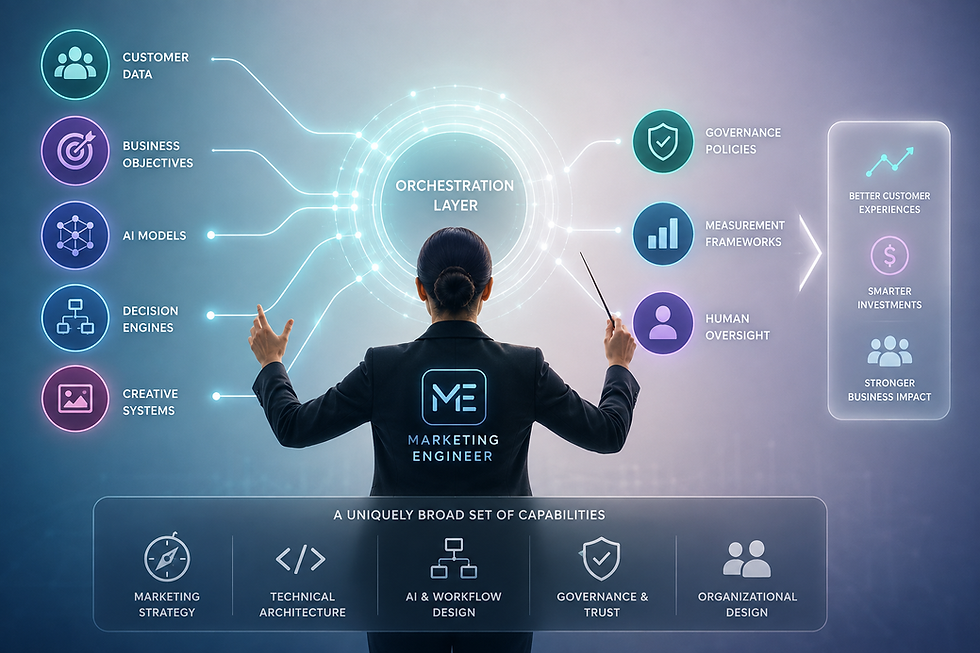
Marketing Engineers are emerging as the architects of the autonomous marketing organization. Rather than managing campaigns directly, they design the orchestration layer that connects customer data, business objectives, AI models, decision engines, creative systems, governance policies, measurement frameworks, and human oversight into a single, coordinated operating model.
Success in this role demands an unusually broad blend of business and technical expertise. On one hand, Marketing Engineers must understand marketing strategy deeply enough to translate business objectives into intelligent systems. But they also need the technical skills to integrate complex platforms and ensure AI operates on trusted, well-governed context, and they must be proficient in prompt engineering and workflow design to guide intelligent agents effectively. And crucially, they need strong organizational and change management capabilities to redesign workflows and operating models that, in many enterprises, have remained largely unchanged for decades.
Perhaps most importantly, they become stewards of judgment. As AI assumes more responsibility for execution, competitive advantage shifts toward designing the systems that determine how decisions are made, what context those decisions consider, and where humans remain essential. The Marketing Engineer is ultimately responsible for engineering that balance. This is why the role feels so different from previous evolutions in marketing. It isn’t another specialization added to the existing organization chart, and instead represents the convergence of multiple disciplines into something fundamentally new—a profession born from the reality that, in the AI era, marketing is no longer just a creative function or a technical function. It is an engineering discipline focused on designing intelligent systems that continuously create customer value.
In the AI era, judgment becomes more valuable—not less. The scarce resource is no longer information. It’s deciding what should happen next.
Marketing Teams Won’t Shrink, But They Will Reorganize.
Every major technology shift has sparked predictions that marketing teams would become dramatically smaller. Marketing automation was supposed to eliminate campaign managers, DIY advertising was expected to replace media buyers, and lest we forget low-code platforms promised to reduce dependence on technical specialists. Yawn. Instead, marketing organizations grew more sophisticated and roles and jobs proliferated. More people work in marketing now than ever before.
Artificial intelligence will likely follow the same pattern. The near-term impact of AI is unlikely to be the wholesale elimination of marketing departments. Instead, it will fundamentally redistribute where humans create value. As intelligent systems assume responsibility for repetitive execution, marketers will spend less time operating software and more time designing systems, defining strategy, governing AI, and improving decision quality.
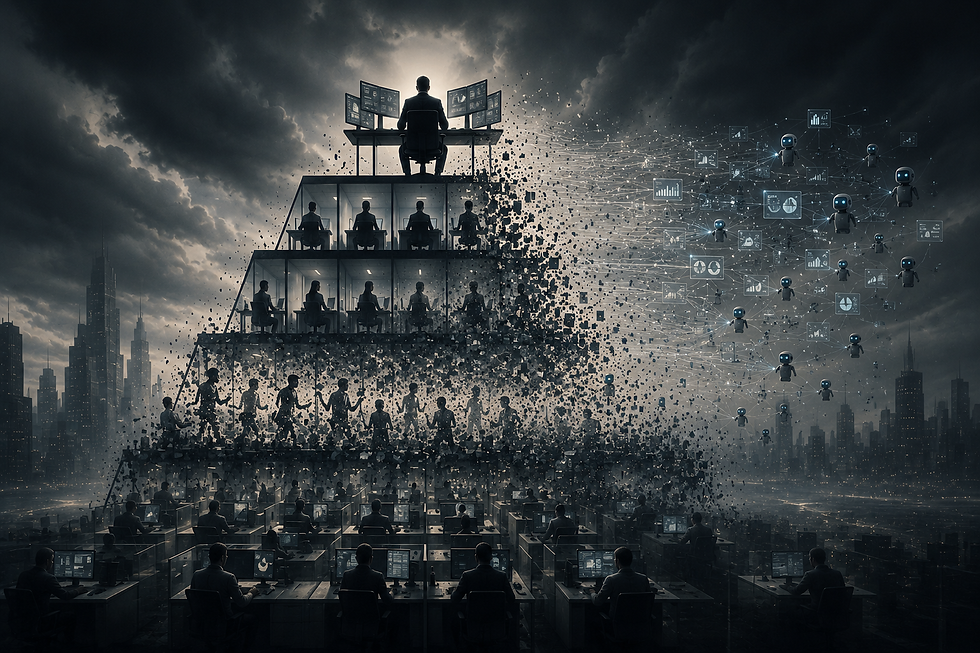
In many ways, AI doesn’t eliminate work. Instead, it changes the unit of work. Keep in mind that historically, marketing organizations were built around execution. Because of this, teams specialized by channel, campaign type, or technology platform. One group managed email, another managed paid media, and yet another managed analytics. Even another administered the CDP or CRM. Each team became experts at operating increasingly complex software, working in a distinct silo.
As AI permeates across the enterprise, it begins to dissolve those boundaries. Instead of humans manually executing every campaign, AI agents will increasingly coordinate work across channels simultaneously. A single customer interaction may trigger dozens of autonomous decisions involving audience selection, offer optimization, creative generation, budget allocation, experimentation, measurement, and reporting—all happening without human intervention.
The future belongs not to the marketers who execute campaigns the fastest—but to those who engineer the smartest systems.
As execution becomes automated, competitive advantage shifts upstream. Organizations will ultimately differentiate themselves through the quality of their data, the clarity of their business objectives, the sophistication of their decisioning logic, and the governance frameworks they build around AI. The companies that win won’t necessarily have the largest marketing departments, they’ll have the best-designed marketing systems.
This fundamentally changes how marketing teams are structured. Rather than organizing primarily around channels, many organizations will increasingly organize around capabilities. Teams responsible for customer intelligence, AI orchestration, experimentation, governance, and knowledge management will become more central than teams dedicated solely to executing campaigns. Traditional specialists won’t disappear, but their expertise will increasingly be embedded into systems that allow AI to execute at scale.
The Marketing Engineer sits at the center of this transformation. Because they understand both marketing strategy and technical architecture, they become the connective tissue between business leaders, data teams, creative organizations, AI specialists, and platform engineers. Their role is not to replace these functions, but to enable them to work together through intelligent systems rather than disconnected technologies.
This is why the rise of the Marketing Engineer represents more than the creation of another job title. It signals a broader evolution in how marketing organizations fundamentally operate. The future marketing department will look less like a collection of specialists operating individual tools and more like a network of humans supervising autonomous systems designed to make millions of decisions on their behalf.
What's more, the marketers who thrive in that environment won’t simply be the best practitioners of yesterday’s disciplines, bur the architects of tomorrow’s operating model.

------------------------------------------------

Rio is an executive with 20+ years at the intersection of strategy consulting, AdTech, data, and media. He's a trusted advisor on customer experience, digital strategy, and marketing transformation. He's a partner at Credera, Omnicom's consulting arm. He's also a podcast host, writer, and public speaker focused on the future of advertising and AI-driven infrastructure.


Comments