
The Middle Manager Extinction Event?

Article by Rio Longacre
Over the past year, a new consensus has begun to emerge in boardrooms, analyst reports, and LinkedIn hot takes: middle management is in deep trouble. Gartner recently predicted that through 2026, upwards of 20 percent of organizations will use AI to flatten their structure, eliminating over half of their middle management positions.
Moreover, recent news seems to support this hypothesis. Major technology companies including Meta, Amazon, Coinbase, and Block have all announced they are flattening their management structures while simultaneously investing billions in AI. Meanwhile, job openings for middle-management roles have fallen dramatically from recent highs as companies experiment with leaner organizational structures.
The logic seems straightforward enough. If AI can summarize information, generate reports, coordinate workflows, answer questions, monitor performance, and communicate across teams, then surely it can absorb much of the administrative work that middle managers have historically performed. As a result, an entire genre of online commentary has emerged around what some have begun calling a "middle-management extinction event."
I think this diagnosis is directionally correct, but also incomplete. The real story is that AI is collapsing roles, though not necessarily replacing managers. Think about it. For decades, organizations have been built around specialized functions. Product managers managed products, designers designed, engineers engineered, marketers marketed, and project managers managed projects. Each role thus represented a distinct capability, encapsulating a distinct workflow, and often an entire occupation or career path.
AI is already beginning to challenge this model. Today, a talented operator equipped with tools like Claude, Codex, Cursor, Lovable, Replit, or Figma AI can increasingly perform work that previously required multiple specialists. A product manager can generate working software, an engineer can create functional designs, and a marketer can produce content, analysis, and creative. Looking at my industry, a single consultant can now build models, write code, conduct research, and develop executive-ready deliverables from a single workflow—the question is no longer whether AI replaces individual tasks. It certainly does.
The question is what happens when entire categories of work begin to merge or collapse together. This phenomenon leads to a another potentially more uncomfortable possibility than the disappearance of middle management: What if AI raises the value of judgment while simultaneously reducing the value of specialization? Because if this is true, the biggest winners of the AI era may not be junior employees or narrowly specialized experts. Paradoxically, the winners may be experienced operators capable of combining deep context, broad business judgment, and AI into a level of leverage that organizations have never seen before.
The Experience Premium—AI Commoditizes Knowledge but Amplifies Judgment
One of the most surprising things I've discovered working with AI is that the value of experience doesn't decline—it compounds. In fact, my experience has been almost the exact opposite of what many people expected, including me. The more expertise, context, and judgment we bring into an interaction with AI, the more valuable the output becomes. We're talking exponentially more valuable.
When I use AI in my day-to-day consulting work, the results are often remarkably good—sometimes approaching client-ready quality with only modest refinement. But that outcome isn't solely a function of the improving models, which is a thing. It's also the product of twenty years spent interviewing executives, leading transformations, solving complex business problems, understanding organizational dynamics, and learning how to separate signal from noise.
I would argue AI isn't generating that context. I am. The same is true of the prompts, documents, interviews, and business challenges that I feed into the system. Many of the inputs themselves are the result of years of accumulated expertise, and the quality of the output is directly tied to the quality of the judgment that shapes the interaction.
This reveals something critically important about the future of work. For years, organizations assumed that expertise was primarily about knowing things. As it advances, AI is rapidly making knowledge abundant—and cheap. By contrast, what remains scarce and therefore dear is judgment, or rather the ability to ask the right questions, identify the important variables, interpret ambiguous situations, navigate tradeoffs, and make decisions under uncertainty.
In other words, knowledge is becoming cheaper, but judgment is becoming more valuable—and this distinction has profound implications for how organizations are structured. Historically, companies assembled teams of specialists because complex work required many different forms of expertise. A strategist created the plan, partnering with analysts to gather the data, and designers to create the UX. They would then hand off to engineers to built the product, overseen by a project manager to coordinate the effort across teams and handoffs.
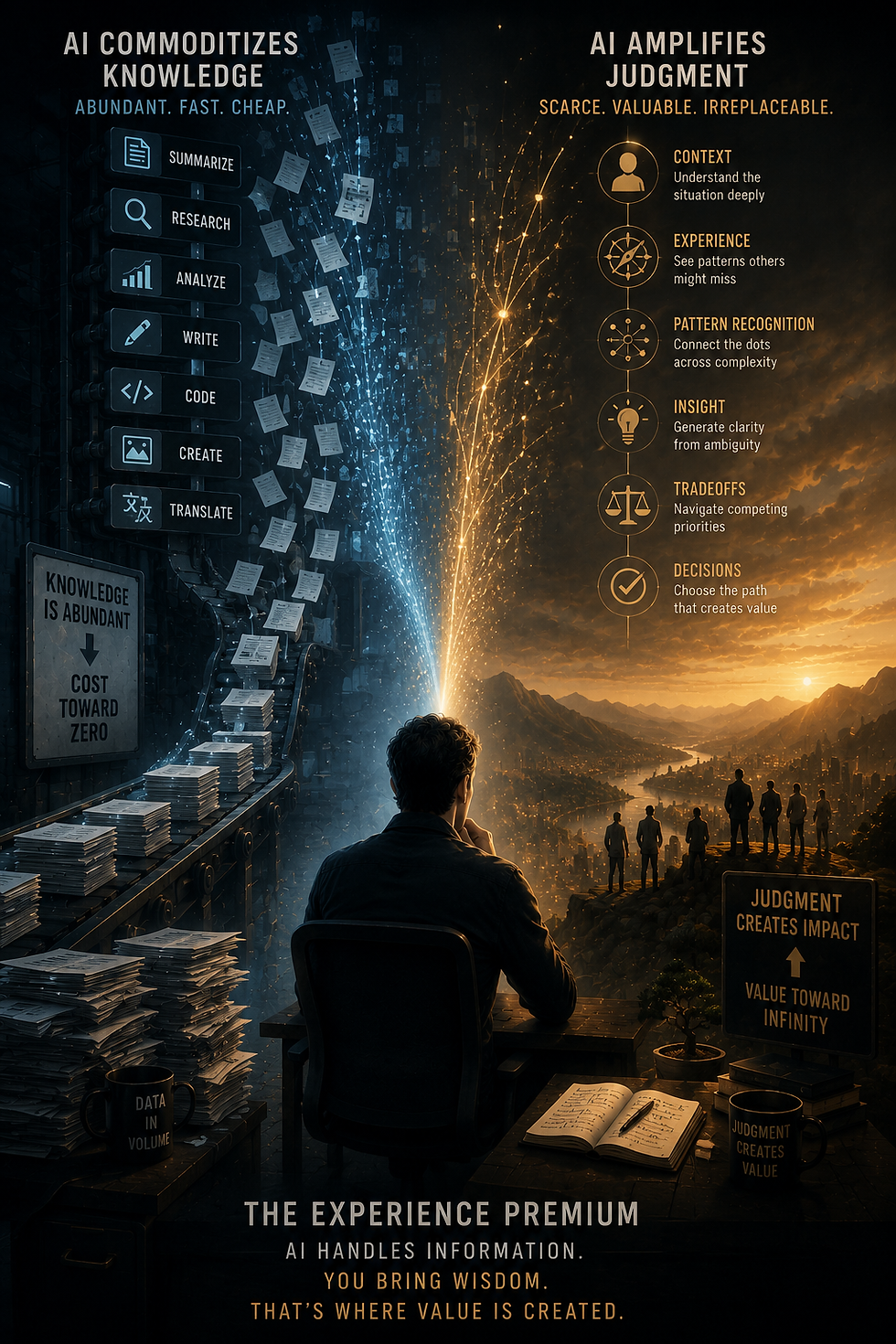
AI increasingly allows a single experienced operator to perform meaningful portions of each of these hitherto distinct functions. This is not because they have become suddenly experts in every discipline overnight, but rather because AI dramatically expands the range of tasks they can perform competently. The end result is more an amplification of leverage than a wholesale elimination of expertise.
Supporting by AI, a senior product leader can now create clickable prototypes that once required design and engineering resources, and a consultant can perform analysis, write code, conduct research, and build executive presentations from a single workflow. Marketers can generate creative, analyze performance, create audience strategies, and launch campaigns with far less support than previously required, or imagined.
This implication is difficult to ignore. Organizations may need fewer specialists, but this shift places an even greater premium on people capable of exercising judgment across multiple domains. If AI is collapsing roles, then experience becomes the force that determines how much value can be extracted from the collapse. This may be the real organizational story of the AI era.
Knowledge Is Becoming Cheaper, but Judgment Is Becoming More Valuable
Of course, there's an important counterpoint to all of this. If AI amplifies expertise, it also amplifies mediocrity. A few months ago, I jokingly referred to this phenomenon on LinkedIn as the rise of the "AI slop cannon"—someone armed with AI tools capable of producing an endless stream of presentations, reports, blog posts, social content, emails, designs, and analyses with almost no effort whatsoever. Barf. Dan Hockenmaier create a neat graphic that summarizes this funny concept.
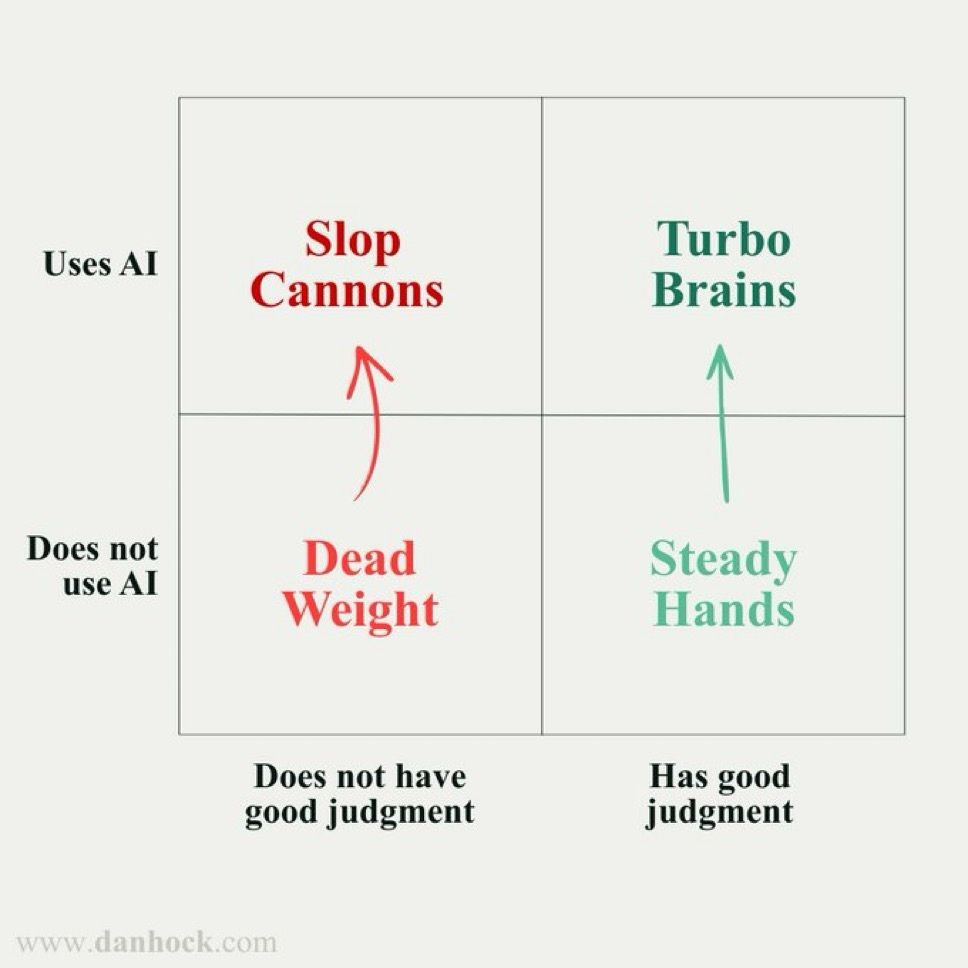
Defining an AI Slop Cannon as someone with poor judgement who uses AI to post content prolifically, the problem is not volume, but value. Without context, judgment, and experience, AI often produces something that looks impressive on the surface but quickly falls apart under any scrutiny. The result is an avalanche of polished mediocrity: content that sounds intelligent without actually saying anything, analysis that summarizes without synthesizing, and recommendations that appear reasonable but lack the nuance required to survive contact with reality.
In many ways, AI has made it easier than ever to create output while simultaneously making it harder to create signal. This distinction is critical because organizations have historically rewarded production. More reports, presentations and documentation usually lead to a pat on the back. Want to get promoted? Then start producing more content and generating more activity. For years, the ability to generate these artifacts was often viewed as a proxy for value creation. Those days are over.
AI is rapidly driving the cost of production toward zero. When anyone with a ChatGTP subscription can generate a strategy deck, write a blog post, create a prototype, analyze a dataset, or produce a week's worth of social content in a matter of minutes, the value no longer resides in the artifact itself. The value shifts to the decisions that shape it.
What should be analyzed? Which problem is actually worth solving? Which insight matters? What tradeoffs should be considered? Which recommendation should be acted upon? These are not questions AI can answer independently. They require context, experience, and judgment.
In other words, the scarce resource in the AI era is not the ability to generate work, but rather the ability to direct it. This means knowing what questions to ask, how to recognize a weak argument or identify a missing variable, and how to understand when a model is wrong. Ultimately, it requires separating correlation from causation, and distinguishing true insight from vacuous chatter.
In other words, AI does not eliminate the need for human judgment. If anything, makes judgment the ultimate bottleneck. And this may ultimately be why experienced operators are becoming more valuable, not less, in the age of AI. Looking ahead, the more knowledge work becomes automated, the more important it becomes to have someone capable of steering the machine in the right direction.

The Coming Apprenticeship Crisis
One of the most under-discussed consequences of AI is that it may ultimately break the traditional pathway through which expertise is developed. This is very important because for decades, organizations operated on a relatively simple model to build their teams. Junior employees couldn't provide a lot of value and needed to gain on-the-job experience. They did this by performing repetitive work—analysts in management consulting built PowerPoint slides, Wall Street associates made hundreds of cold calls, agency workers trafficked campaigns. and associate attorneys spent countless hours doing document review.
Much of this work was tedious, and some of it was certainly low-value. But it was necessary and served an important purpose: It was how people learned. Suffice it to say, the first decade of most careers is not really about producing much value. This time is about accumulating context, which means learning how organizations operate, gaining an understanding of customers, developing judgment, and of course making mistakes. Through repetition, junior workers thus build pattern recognition and discover through trial and error which signals matter and which can be ignored.
In other words, the work itself was often the training program—and AI is beginning to disrupt this model.
Many of the tasks historically assigned to junior employees are exactly the kinds of activities AI performs exceptionally well. Research, documentation, summarization, data analysis, first drafts... The list goes on and on.
As organizations adopt AI, there will be enormous pressure to eliminate these activities from human workflows entirely. The problem is obvious but difficult to solve—and the end result is bleak. If AI performs the work that traditionally created experience, where do future experienced operators come from? How does someone become a great consultant if AI performs much of the analysis? How does someone become a strong product leader if AI creates the specifications, prototypes, and user stories, or a skilled marketer if AI handles campaign execution, audience analysis, reporting, and content production?
Every profession has historically relied on an apprenticeship model, whether formally acknowledged or not. Junior people learned by doing. Over time they accumulated the judgment that eventually made them valuable.
AI threatens to compress or bypass portions of that journey. Ironically, the very technology that increases the value of judgment may simultaneously reduce the opportunities available to develop it. This creates a challenge that organizations have not yet fully grappled with: the future may require fewer people, but will still require experienced people, and experience has to come from somewhere.
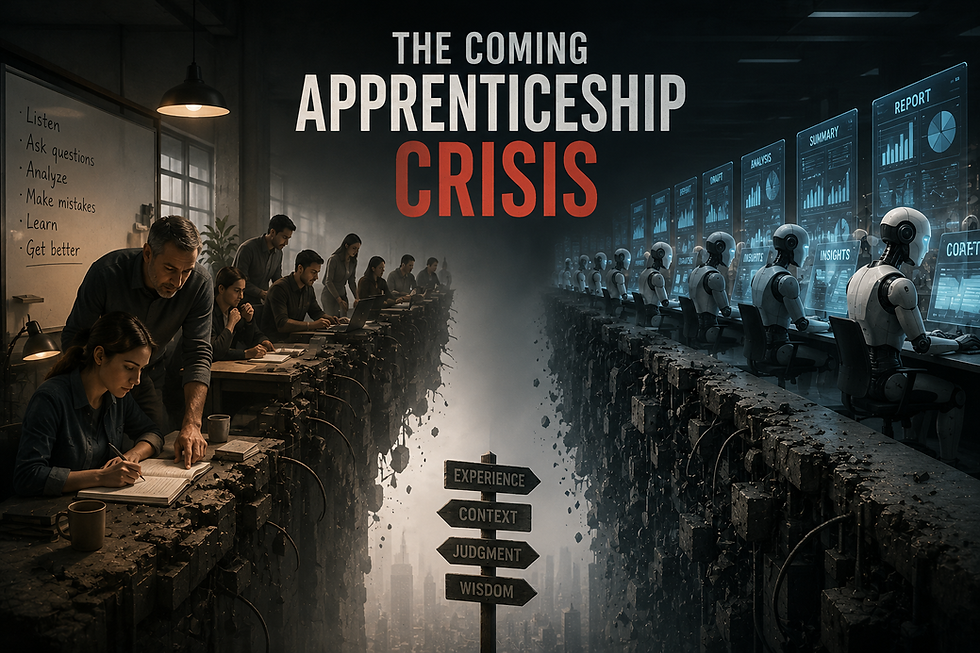
The Experience Pipeline Is Breaking
As organizations adopt AI, there will be enormous pressure to eliminate these activities from human workflows entirely. After all, why pay an analyst to spend eight hours building a PowerPoint deck when AI can produce a first draft in thirty seconds? Why assign a junior consultant to summarize interview notes, a junior marketer to pull campaign reports, or a junior engineer to write boilerplate code when increasingly capable models can accomplish the same tasks almost instantly?
From a productivity standpoint, the logic is difficult to argue with. The problem is that many organizations may be unknowingly eliminating the very work that historically produced experienced operators in the first place. A real Catch 22.
I consider my own career. I didn't start by advising executives, leading transformations, developing points of view on AI, or even writing articles like this one. Like most consultants, I spent years building presentations, gathering requirements, analyzing data, documenting processes, taking notes in meetings, and performing countless other tasks that were neither glamorous nor particularly strategic.
At the time, much of that work felt transactional, and some of it was frankly difficult or boring. Looking back, those activities created the foundation that everything else was built upon, and taught me how organizations actually operate. They exposed me to hundreds of business problems, stakeholder interactions, political dynamics, technology decisions, and implementation challenges. They developed the pattern recognition that today allows me to quickly identify risks, ask better questions, and generate more valuable outputs from AI systems.
In many ways, expertise is simply accumulated context, and context is expensive to acquire.
This creates a dilemma that few organizations have fully grappled with. If AI increasingly performs the work that historically allowed junior employees to accumulate context, where do future senior employees come from? Rather, how does someone become a great consultant if AI performs much of the analysis, or a strong product leader if AI writes the requirements, generates the prototype, and creates the user stories? Looking at marketing, how does someone become a skilled marketer if AI handles audience research, campaign execution, content creation, and reporting?
Though we may be loathe to admit it, every profession relies on some form of apprenticeship, whether formally acknowledged or not. The specific tasks may vary, but the underlying mechanism is more or less the same. People develop judgment by repeatedly encountering situations, making mistakes, observing outcomes, and gradually building the mental models required to navigate ambiguity.
AI threatens to compress that journey, so ironically, the same technology that increases the value of judgment may simultaneously reduce the opportunities available to develop it. For business leaders, this may become one of the defining talent challenges of the next decade.
The Great Compression
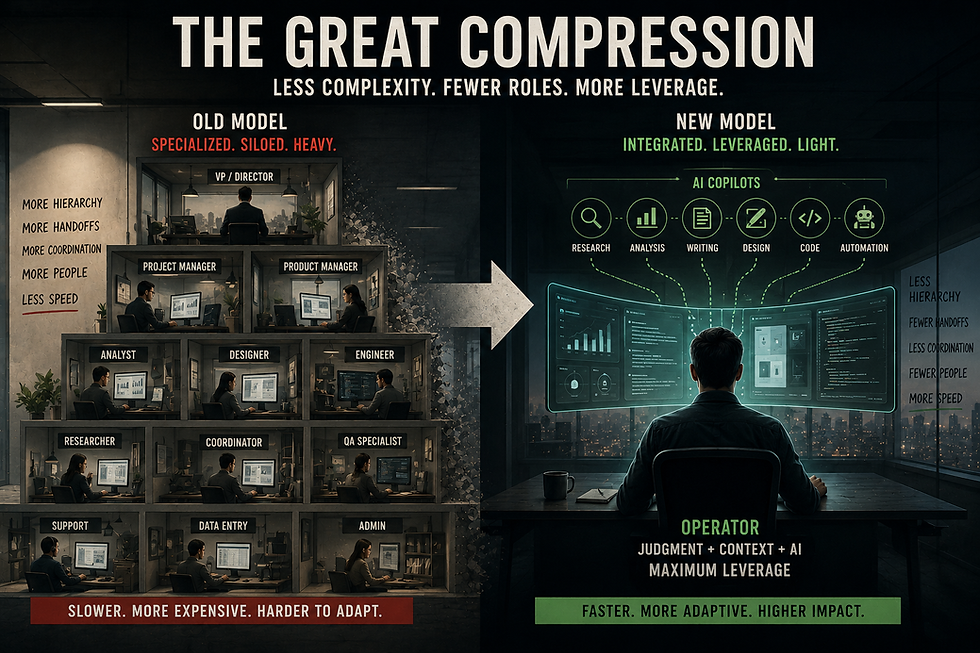
If the last twenty years were defined by specialization, the next decade may be defined by compression.
Historically, organizations solved complexity by adding people. If a project became larger or more complex, additional project managers were added. As work moved forward, product teams gained researchers, designers, front-end developers, back-end developers, QA specialists, scrum masters, analysts, and coordinators. Over time, marketing organizations expanded by adding channel specialists, audience specialists, measurement specialists, creative specialists, operations specialists, and platform specialists.
The assumption underlying this model was simple: as work became more complex, organizations needed more specialized expertise to execute it. Now AI is beginning to challenge this assumption.
Today, a single experienced operator can increasingly perform meaningful portions of work that once required entire teams. Product leaders can generate prototypes, marketers can build creative, consultants can write code, and engineers can create user experiences. The boundaries separating these functions are becoming increasingly porous.
This does not mean expertise disappears, but it does become more concentrated. Instead of 10 specialists each contributing a narrow slice of value, organizations may increasingly rely on smaller groups of highly capable operators supported by AI systems that amplify reach. As a result, work that previously required a team of 20 may eventually require five. Work that once required five may soon require one.
The result is what I think of as organizational compression. Fewer handoffs or coordination layers, supported by fewer specialists or managers. In other words, more leverage. This helps explain why so many organizations are simultaneously investing heavily in AI while flattening structures. The goal is not simply cost reduction, but rather the reduction of friction created by organizational complexity.
For decades, companies optimized for scale through specialization. Now, they may optimize for speed through leverage, and this shift could fundamentally reshape how organizations are designed.
The Future Belongs to Operators
Taken together, these trends suggest that the future of work may look very different than either the AI optimists or the AI doomers predict. Again, the popular dystopian narrative is that AI will replace workers. The more optimistic version is that AI will simply make everyone more productive. Both perspectives contain elements of truth, but neither fully captures what is happening.
My hypothesis is AI is not merely automating work, but reorganizing it. The organizations emerging on the other side of this transition will likely be flatter, smaller, and more heavily leveraged than those that came before them. They will rely on fewer handoffs and layers of coordination, supported by fewer narrowly defined roles. They will increasingly be built around experienced operators capable of directing AI systems across multiple domains simultaneously.
This is why I believe the debate around middle management, while interesting, ultimately misses the larger story. The real disruption is that the boundaries between manager, analyst, strategist, designer, engineer, marketer, researcher, and operator begin to blur. Many of the organizational structures we take for granted today were built around the assumption that expertise had to be fragmented across large teams of specialists, and AI is beginning to challenge that assumption.
The winners in this new environment will not necessarily be the people with the deepest expertise in a single narrow discipline. Nor will they simply be the people who know how to use AI tools—this will be tablestakes. The winners will be those capable of combining judgment, context, experience, and AI into a level of leverage that was previously impossible.

So in many ways, the future belongs to operators, or people who understand how businesses work, navigate ambiguity, and make decisions with incomplete information. These will be people who know which questions to ask, which tradeoffs matter, and which signals deserve attention. As AI continues to drive the cost of knowledge, production, and execution toward zero, these skills become the scarce resources.
Let's not forget that in economics, scarcity is where value accumulates. The irony is that the more powerful AI becomes, the more important human judgment may become alongside it—not because humans remain better at every task, but because somebody still has to decide what is worth doing.
As we look back, this may be the ultimate lesson of the AI era. The future will not belong to the managers, nor will not belong to the machines. It will belong to the operators who learn how to combine both.
------------------------------------------------

Rio is an executive with 20+ years at the intersection of strategy consulting, AdTech, data, and media. He's a trusted advisor on customer experience, digital strategy, and marketing transformation. He's a partner at Credera, Omnicom's consulting arm. He's also a podcast host, writer, and public speaker focused on the future of advertising and AI-driven infrastructure.


Comments