
The IRL Rebellion: Why Real People and Real Experiences Are Rewriting the B2B Playbook

AI flooded the system with content—so trust snapped back to people, proving that in a synthetic world, real human connection isn’t optional… it’s the advantage.
Something important is happening in tech and business right now. After a decade of relentless digital acceleration—and a couple years of AI-slop content overload—the pendulum is swinging hard in the opposite direction. For real. We’re entering what I’d call the IRL Era, where authenticity, human presence, and lived experience are the real differentiators.
The spark for this piece came from a recent LinkedIn post about startups hiring “IRL leads.” My first reaction was skepticism. It sounded like another AI-generated clickbait post discussing a role that didn’t exist three years ago. But the description was telling: coordinating in-person events, building real communities, managing outreach lists, and creating authentic, relevant content to support those interactions.
On paper, it looked like a standard GTM role. In practice, it was something different. The center of gravity wasn’t funnels or automation—it was people. Building communities through in-person experiences, then sustaining those relationships with credible, human communication. That’s the shift.
The IRL Era is a direct response to the world we just lived through. COVID forced an unprecedented experiment in virtual everything—selling, collaborating, learning, even socializing. It worked, until it didn’t. Then came the tidal wave of AI-generated content, and whatever signal was left got buried.
Buyers, teams, and leaders now want something fundamentally different. They want real interactions with real people. Conversations with nuance, tone, and context—not another Teams meeting or webinar. Insight from practitioners who’ve actually done the work, not polished corporate scripts or AI filler. As digital channels flood with interchangeable content, IRL interactions are becoming premium and trusted.
This isn’t nostalgia for a pre-pandemic world. It’s a structural correction—maybe even an overcorrection—back toward human connection. And it’s already reshaping how we market, sell, network, and work.

Why IRL Is Surging—and Why It’s Not Going Away
After years behind screens, people are rediscovering what the shift to digital stripped out. Zoom made relationships two-dimensional at best. Physical spaces, by contrast, restore tone, body language, spontaneity, and the side conversations where trust actually forms. That’s why conferences, meetups, and curated dinners are booming. This year’s AWS reinvent, the hyperscaler’s annual conference that I attended last Fall in Las Vegas, counted more than 70,000 attendees, up 10,000 from the previous year. The fact these events are surging demonstrates that trust simply forms faster in person than it ever will through a webcam.
At the same time, AI has made content cheap and abundant, but not meaningful. We’re drowning in what can only be described as content-like substances, to riff on Michael Pollan’s Eater’s Manifesto. The problem is most people can spot AI-generated fluff a mile away and have already learned to tune it out. As automation increases, and the volume of low-quality content expands like a balloon, it stands to reason that trust will flow back to humans with reputational skin in the game. The more synthetic the internet becomes, the more people crave what feels grounded, opinionated, and real.
This has also triggered a cultural reset. The pandemic era intensified performative online behavior, where nuance disappeared and people walked on eggshells in fear of getting dogpiled or, godforbid, canceled. This isn’t about being provocative—people just want to speak honestly again. IRL environments allow for that. You can disagree without being quoted out of context and having the woke mob come running with pitchforks. You can say the wrong thing and correct it. You can read the room. You can be human.

The B2B Playbook Has Been Rewritten
These same trends have absolutely eviscerated the traditional B2B go-to-market playbook, which was frankly broken and in dire need of a refresh anyway. Buying lists, blasting emails, automated cadences, dialing for dollars—buyers have learned to ignore all of it.
Just how bad is it? I did a short stint at a startup earlier this year and was shocked to see more than 2,000 email opens and not a single form fill—I assumed something was broken. Rigorous testing revealed nothing. It turns out people are sick of filling out forms and getting harassed by SDRs. Now, emails get filtered, InMails go unread, calls from unknown numbers go unanswered. It’s not apathy, it’s defense against overload.
More importantly, buyers aren’t sitting in funnels waiting to be nurtured. They’ve moved elsewhere. They’re learning in niche communities, listening to podcasts, following practitioners on LinkedIn, attending invite-only events, and trading ideas in Slack and WhatsApp groups. Opinions form there. Decisions start there—long before a vendor shows up.
The companies winning today understand an uncomfortable truth: you don’t go directly to buyers anymore. You go to the people buyers trust. Influence now flows through human networks, not marketing automation platforms. If your GTM strategy assumes attention can be purchased and forced, it’s already obsolete.

This has created a new class of influence in B2B. The most trusted voices aren’t brand accounts or research firms like Forrester or Gartner. They’re practitioners—people who have built systems, led teams, and lived through the tradeoffs. They show up consistently, speak plainly, and share what they know. This is why emerging platforms like Marketecture Media and a host of awesome B2B podcasts are thriving. Buyers want independent voices with credibility, not pay-for-play vendor narratives pretending to be thought leadership.
At its core, this is about trust. People would rather learn from someone who has done their job than from someone trying to sell them a solution. Credibility is decentralized. If your company doesn’t have real, recognizable humans who can speak credibly to your audience, you don’t have a modern GTM motion—you have a content engine talking to itself.
Consulting Has Shifted to IRL Too
Consulting is undergoing a quiet but equally radical restructuring. The traditional pyramid model with armies of junior analysts feeding a small group of partners is breaking down. In its place, an obelisk-shaped model is emerging. This means fewer people overall, featuring a heavy concentration of senior practitioners, with AI replacing much of the work that once justified large junior teams. Clients are forcing this shift through their expectations for lower costs, leaner teams, and quicker timelines.
For decades, consulting firms made money through a leverage (i.e., pyramid) model. Clients paid for smart generalists from top schools, even if many were learning the industry in real time (often on airplanes).
The problem is, that no longer works. Clients aren’t buying pedigree. They want practitioners—people who’ve lived the role, know the industry, and can go deep without a script. They want peers, not a bunch of Harvard MBA 20-somethings telling them how to run their business.
AI is the accelerant. Research, synthesis, modeling, documentation—much of the work once done by junior teams can now be handled faster and cheaper by AI copilots. As a result, clients increasingly refuse to pay for junior staff at all. What they’re willing to pay for is judgment, pattern recognition, networks, and experience—all things AI can support but not replace.
The economics have shifted. Projects move faster, teams are smaller, and engagements are both shorter and more focused. Prices are coming down—not because the work is less valuable, but because it’s delivered with far less waste or theater. A coupler senior experts augmented by AI routinely outperform twenty-five generalists operating under the old model—I know this because I am doing this today at Credera.
At the same time, consulting has become more IRL, not less. What I mean by this is not that more activates are necessarily happening in person—we proved during the pandemic that much of this work can be done remotely. What I’m referring to in an increased “workshop” approach to consulting delivery in which teams work with clients in a collaborative model. We review work products as they are being produced, gaining real-time feedback, pivoting, revising, and turning around quickly for the next iteration.
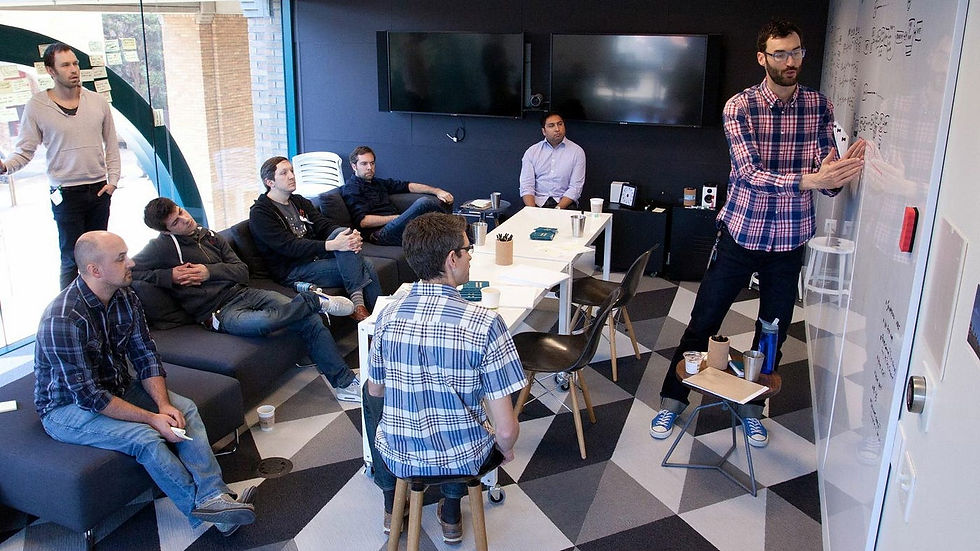
As timelines compress and teams shrink, trust and alignment matter more. Whiteboard sessions, on-site workshops, and embedded delivery are re-surging because they collapse weeks of async communication into hours of real conversation. Clients want consultants who will sit with them, think with them, and build solutions together—not disappear into a war room and reappear weeks later with a deck.
Why the Companies That Embrace IRL Will Win
B2B has become a game of influence. The linear buyer journey is gone, replaced by a continuous stream of ideas absorbed from trusted humans across fragmented media and real-world interactions. Influence isn’t controlled anymore—I would argue it’s now earned.
The strongest B2B organizations are actively building networks of practitioners, not trying to generate funnels of leads. Identifiable experts who show up with credibility and a point of view naturally attract communities of likeminded individuals. Those communities generate demand far more effectively than gated content or nurture sequences ever did.

This has given rise to new media channels that blur content, community, and commerce. Some of these include micro-events, live podcasts, invite-only working groups, and practitioner roundtables. Don’t be fooled into thinking these are side tactics—they’re becoming the core GTM motion. People want to learn alongside peers, through conversation and debate, not be “nurtured” by software, annoying SDRs, or spammy emails.
IRL is the trust multiplier. As AI reshapes search and floods digital channels with interchangeable content, physical presence becomes a filter for credibility. Showing up in a room gives ideas weight, and accelerates trust in ways digital alone increasingly can’t.
Conclusion: AI Didn’t Replace Human Connection—It Made It More Valuable
AI didn’t kill human connection, it made it more valuable. In a world where content is infinite, automation is table stakes, and attention is scarce, real human presence has become the ultimate competitive advantage. The companies that win the next era of B2B won’t be the ones shouting louder or automating harder. They’ll be the ones who show up—with real people, real experience, and real opinions.
The IRL Era isn’t anti-technology. It’s a rebalancing. AI handles the scale and efficiency, while humans deliver trust and credibility. Organizations that recognize this shift now won’t just outperform—they’ll build relationships their competitors can’t replicate, automate, or fake. That’s the rebellion, and it’s already well underway.
----------------------

Rio is an executive with 20+ years at the intersection of strategy consulting, AdTech, data, and media. He's a trusted advisor on customer experience, digital strategy, and marketing transformation. He's a partner at Credera, Omnicom's consulting arm. He's also a podcast host, writer, and public speaker focused on the future of advertising and AI-driven infrastructure.


Comments