
From HoldCos to Operating Systems
Updated: Apr 24
Why the future of agencies will be built on data, platforms, and infrastructure — not portfolios of services

By Rio Longacre
Now is the Time of Monsters
For most of the past three decades, the global advertising industry has been organized around a familiar structure: the holding company, or HoldCo. This model was built through serial acquisition. Companies like Omnicom, WPP, Dentsu, Havas, and Publicis assembled vast portfolios of agencies across creative, media, PR, and specialized services. What emerged was not a unified system, but a federation — a collection of businesses loosely connected by financial ownership rather than operational integration.
Within this model, agencies operated with significant independence. They maintained their own leadership, culture, and client relationships, while the HoldCo provided capital, reporting structure, and scale. Coordination was limited by design. In many cases, agencies within the same holding company even competed against each other. For its time, it worked. It may have even been elegant. The structure enabled rapid expansion without sacrificing the entrepreneurial energy that made agencies valuable in the first place. It allowed these organizations to scale globally while remaining locally relevant and commercially flexible.
But the conditions that made this model effective are starting to break. The economics of the agency business — particularly media — are under increasing pressure. Margins are tightening, complexity is compounding, and the systems required to compete are no longer compatible with a loosely federated structure.
The model isn’t just strained, it’s fragmenting. Because what’s becoming clear is that the holding company category is no longer a single model. It’s splitting. Some organizations are beginning to re-architect themselves into integrated operating companies — built on shared data, common platforms, and centralized technology infrastructure. Others are still functioning largely as assemblies of capabilities — strong agencies, connected by brand and balance sheet, but not fully integrated at the system level.
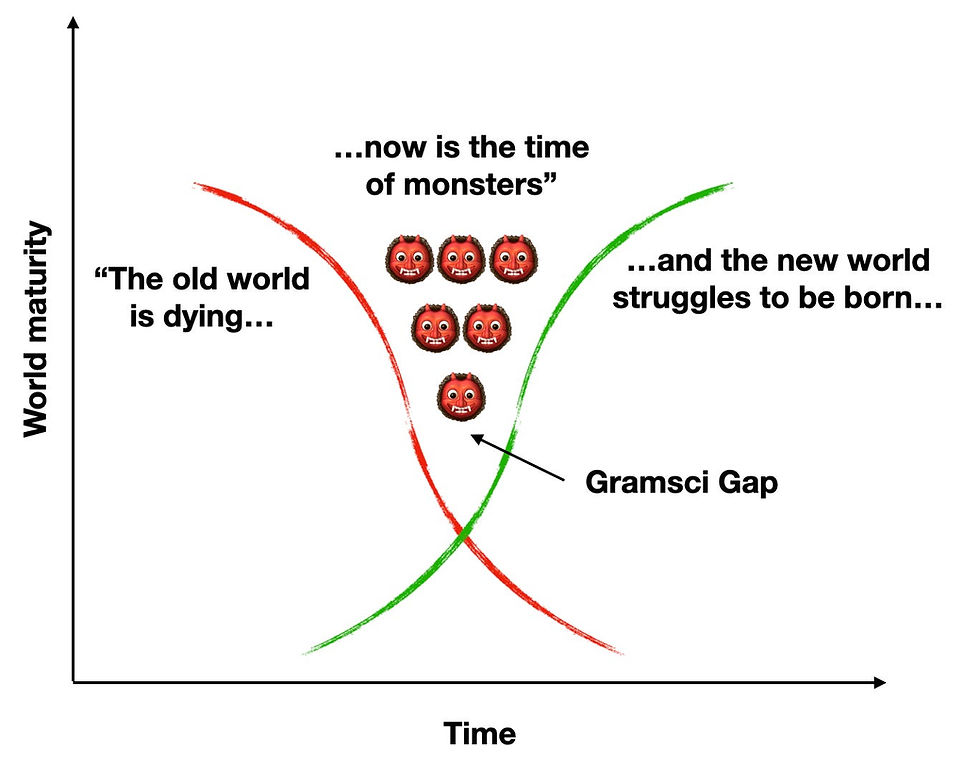
That divergence is still early, but it’s real and it’s accelerating. This is happening because what we are living through now can be deemed a transition period — an interregnum — where the old model is visibly breaking down, but the new one has not fully taken hold. As Italian philosopher Antonio Gramsci wrote: "The old world is dying, and the new world struggles to be born: now is the time of monsters."
The Agency Business is a Media Business
To understand how this transition is forming, you have to start with the part of the business that actually drives it: media. Media is no longer just one capability among many, but it is inarguably the economic engine of the modern agency.
According to analyst firm Madison and Wall, roughly 30 percent of global HoldCo revenue comes from media agencies. More importantly, media has driven nearly two-thirds of large agency group growth over the past decade. At Omnicom’s most recent Investor Day, CEO John Wren put it even more plainly: media and media-related services are expected to account for 58 percent of total revenue. That number is not just a data point. It’s a signal.
Over time, media has become the center of gravity for the entire agency model.
This shift traces back to the unbundling era of the 1980s and 1990s, when agencies separated media buying from creative to improve margins and achieve scale. What began as a financial optimization became a structural transformation.
Model in place, media agencies scaled aggressively as ad spend grew and become increasingly digital. They built global buying power, centralized planning systems, and increasingly sophisticated optimization engines. Billions of dollars began flowing through these organizations. And as that happened, something more fundamental changed. The agency business stopped being a collection of services, and became rather system for managing and optimizing media at scale.
This is where the current divergence begins to make sense. Because once media becomes the core of the business, the question is no longer just how efficiently you buy it.
The question becomes: what system sits behind it? Is it a collection of agencies coordinating loosely across clients and channels? Or is it an integrated operating model — with shared identity, unified data, centralized platforms, and the engineering capability to connect it all? This is the fault line now running through the HoldCo world. And it’s about to get much wider.

The Quiet Pressure on the Media Business
But the economics that led to the HoldCo model are shifting in ways that are difficult to ignore. Several forces are converging at once. First, advertisers are demanding greater transparency across the media supply chain. Over the past decade, scrutiny around rebates, markups, and programmatic fees has intensified. Brands increasingly expect agencies to disclose how media dollars move through the system and where margins are being generated. What was once opaque margin is gradually becoming visible cost.
Second, like it or not, procurement has become a central force in agency selection. Marketing leaders once chose agencies based on strategy, creativity, and relationships. Today, procurement teams evaluate agencies through a far more transactional lens, comparing CPMs, fees, and rate cards across competing proposals. When media buying is evaluated primarily on cost efficiency, the business inevitably becomes commoditized, or a “race to the bottom” ensues, as we like to say in the media business.
Third, many brands are building their own internal media capabilities, or what's often referred to as in-housing. Self-serve platforms from companies like Google, Meta, and Amazon and the rise of SaaS have made it easier for advertisers to run campaigns directly. In response, brands are hiring internal media teams and investing in their own tools and data infrastructure. As AI disruption works its way across the advertising value chain and democratizes both tasks and workflows, this trend is certain to accelerate.
The result is a structural compression of agency margins. While still profitable, media buying is no longer the defensible economic moat it once was. This reality is forcing agencies to rethink where their value actually comes from, how they’re organized, what they invest in, and how they go to market.
The Strategic Response: Services to Systems
As the economics of the agency business have come under pressure, the industry’s response has been both predictable and revealing. Agencies are building. Not just services or tools, but core infrastructure.
Across the board, holding companies have begun investing in proprietary platforms, data assets, and AI-driven systems designed to move them up the value chain. The objective is straightforward: own more of the system that sits behind media, rather than simply executing within it. In practical terms, this means building three layers of proprietary capability — technology platforms, data and identity infrastructure, and increasingly, AI-powered orchestration layers that automate planning, activation, and optimization across channels.
On the surface, nearly every major holding company appears to be moving in this direction. Omnicom has invested heavily in OMNI and its next-generation OMNI+ platform. Publicis has built CoreAI, anchored by Epsilon and its deterministic identity graph. WPP has introduced WPP Open, positioning it as an AI-powered marketing operating system for its agencies. Even outside the traditional HoldCos, the pattern holds. Horizon Media has developed Blu, and Stagwell has assembled its Marketing Cloud. Everyone is talking about platforms, AI, and data.
But this is where the surface-level narrative starts to break down. Because while the direction of travel is consistent, the depth of execution is not. Some of these investments are becoming the foundation of fully integrated operating models — tightly coupled systems where data, identity, platforms, and execution are designed to work together.
Others are layering technology on top of existing structures — enhancing the model, but not fundamentally changing it.
This is an important distinction that matters more than it might appear. This is because the future of the agency business will not be defined by who has a platform, but rather by who has an operating system. And those are not the same thing.

From Holding Company to Operating Company
These shifts are not just changing what agencies do. They are changing how they are built. The traditional holding company was never designed to operate as a unified system. It was a financial construct — a portfolio of agencies organized around ownership, not integration. Each business ran largely independently, with its own leadership, culture, and client relationships. Shared infrastructure was minimal. Coordination was often manual. The model worked because it didn’t need to be tightly connected. But this logic breaks in the platform era.
Technology platforms, identity graphs, and AI systems are not modular add-ons. I would argue they are foundational infrastructure. They require sustained investment, centralized governance, and — most importantly — scale. A platform that is fragmented across dozens of agencies is not a platform. It’s a collection of tools.
Which is why the economics are starting to favor integration over federation.
To make these systems work, they have to be deployed consistently across the organization — not selectively, not optionally, and not differently in every market. Data models need to align. Identity needs to resolve across clients and channels. Platforms need to connect planning, activation, and measurement into a single workflow. And none of that happens in a loosely coupled network.
This is what’s driving the shift from holding company to operating company.
In an operating company model, the core layers — data, identity, platforms, and engineering — are centralized and shared. Agencies still exist, brands still matter, and client relationships still sit at the edge. But they no longer operate as independent systems. They operate on top of a common foundation, and that distinction is everything.

Once the system becomes the product, the question is no longer how strong your individual agencies are. It’s how well the system works. This is the fault line now running through the industry. Some companies are rebuilding themselves around that reality — investing in shared infrastructure, aligning their organizations, and forcing integration across the network. Others, by contrast, are still operating as portfolios — strong in capability, but fragmented in execution.
This is the difference between an operating company and an assembler.
And it is increasingly the difference between competing in the next era — and being left behind by it.
The New Divide: Operators vs Assemblers
The agency market is no longer a single category. It’s splitting. On one side are companies trying to become operating systems for modern marketing — integrated, infrastructure-driven organizations. On the other are those still functioning as assemblies of capabilities — strong agencies, loosely connected.
Omnicom and Publicis are the clearest examples of the first model. At the execution layer, nothing has changed. Omnicom still runs massive media operations through OMD and PHD. Publicis does the same with Zenith, Starcom, and Spark. Media remains the front door, and the divergence starts behind it. At the data layer, both companies made decisive, scaled bets. Omnicom has Acxiom and Real ID, while Publicis has Epsilon and CoreID. These are not partnerships — they are owned identity infrastructure. In a world where identity is the most fragile and valuable layer in the stack, that ownership matters.
By contrast, WPP never made a comparable move. It has strong capabilities across media, creative, and commerce, but it does not own a scaled identity spine. And that gap becomes more visible with every shift toward first-party data and AI-driven activation.
Havas sits somewhere in between. It has invested in its Converged platform and is clearly pushing toward a more integrated model, but it lacks the scaled identity and data infrastructure that underpin the operator approach. Without a proprietary identity spine or a deeply embedded data layer, its platform is more connective tissue than core system. For now, it remains closer to an assembler than a true operator.
At the platform layer, everyone is investing: OMNI, Core, WPP Open, and Havas Converged. But these are not equivalent. OMNI and Core are extensions of fully integrated systems — tightly coupled to owned data, identity, and operating models. Converged signals Havas’ push toward that same direction, but without a scaled, proprietary data foundation underneath it, the platform functions more as an integration layer than a true system of record. WPP Open is directionally similar in ambition, but sits on top of a less cohesive foundation. This raises a more fundamental question: how much leverage can a platform layer really create if it doesn’t control the data layer beneath it?
Now let's turn to systems integration and advisory. Omnicom acquired Credera. Publicis has Sapient. Dentsu owns Merkle. These are not adjacent capabilities — they are the engines that allow these organizations to design, build, and operate complex marketing systems. They turn strategy into infrastructure. WPP, by contrast, remains more dependent on partners to build those systems. Havas faces a similar constraint. While both can advise, orchestrate, and activate, neither has invested at the same scale in owning the engineering layer. In an era where architecture is the advantage, that dependency is not trivial.
And then there is InfoSum, WPP's data collaboration play. On paper, it’s a bet on clean rooms. In reality, it’s a bet on a layer that is quickly becoming commoditized. Every major platform now has its own — from Amazon and Google to Meta, The Trade Desk, LiveRamp, Snowflake, and AWS. Clean rooms are no longer scarce — they’re table stakes.
And this creates a tension. By owning one, WPP isn’t just enabling collaboration — in some cases, it’s competing with the very platforms it depends on. And for brands building their own data environments, the value of an agency-owned intermediary is increasingly unclear.

Put it all together, and the pattern is clear. Omnicom, Publicis, and to some degree Dentsu are building vertically integrated operating models — identity and data at the core, platforms to orchestrate, engineering to implement, and media to activate. WPP and Havas are still more horizontally assembled — strong agencies, strong partnerships, an emerging platform layer, but without the same ownership of data and engineering infrastructure.
In other words, this gap is widening. And if it doesn’t close, WPP and Havas won’t just be at a disadvantage, they will become candidates for consolidation — the missing piece in someone else’s operating model. Accenture Song, TCS, or Deloitte Digital?
The Future Agency Operating System
If the divide is between operators and assemblers, this is what the operators are actually building. Step back from the individual announcements, platforms, and acquisitions, and a consistent architecture starts to emerge. Let's call it the Agency Operating System. The next-generation agency is not a collection of services. It’s a system — built on four interconnected layers:
Layer 1: Media Execution
At the foundation remains media planning, buying, and optimization. Agencies still manage enormous volumes of advertising spend, and their ability to navigate fragmented media ecosystems remains valuable. But this layer is becoming increasingly competitive and margin constrained. Media execution remains critical, but it is no longer the sole source of differentiation.
Layer 2: Engagement Platforms
Above media execution sits the engagement platform layer. These platforms function as the operating systems for modern marketing organizations. They connect planning, audience activation, creative workflows, measurement, and optimization into a unified environment.
Platforms like OMNI, WPP Open, Horizon Blu, and Stagwell’s Marketing Cloud are designed to automate decision-making and enable cross-channel orchestration at scale. In many ways, this layer becomes the brain of the agency.
Layer 3: Identity and Data Assets
The platform layer is powered by data — specifically identity infrastructure that allows marketers to understand and reach audiences across channels. Assets like Acxiom’s Real ID graph and Publicis’ Epsilon identity platform provide the deterministic data foundation required for modern targeting and measurement.
As third-party cookies fade and privacy regulations expand, first-party identity is becoming one of the most strategically important assets in the marketing ecosystem. Identity is the fuel that powers the platform.
Layer 4: Consulting and Systems Integration
The final layer is often overlooked, but it may ultimately be the most important. Think of it as the glue that holds the entire structure together, Consulting and systems integration capabilities allow agencies to implement the data architectures, cloud infrastructure, and AI workflows that modern marketing increasingly depends on.
This includes designing data pipelines, integrating CDPs and clean rooms, implementing AI models, and connecting marketing systems with enterprise technology stacks. In other words, agencies must now operate not only as marketers, but as technology integrators.
When these four layers operate together, the agency becomes something very different from the traditional service provider. It becomes a marketing operating system — and I'll bet dollars for doughnuts this is the model that ultimately prevails.
The Agency of the Future
The current model may be showing wear, but agency HoldCos are not disappearing, and agencies are not going to go away anytime soon. One industry person I know recently compared agencies to cockroaches, quipping that agencies would survive a nuclear war. Like cockroaches, agencies are very good at adapting — though they usually do it when pressed against a wall. I am arguing that time is now.
For decades, agencies competed on planning, buying, and managing media. That still matters. But it’s no longer the center of gravity. Media execution is being automated, platforms are absorbing more of the workflow, and margin pressure isn’t going away.
The next generation of agencies won’t win because they buy media efficiently. That’s table stakes. They’ll win because they can integrate data, operate platforms, deploy AI, and build the systems that modern marketing runs on.
Media will remain the front door. But the real differentiation — and increasingly the economics — will come from the layers behind it: platforms, identity, and engineering.
In other words, the future of agencies won’t be defined by how they buy media. It will be defined by how they build and operate infrastructure.
The companies that figure this out will look less like holding companies and more like operating companies — combining media, data, technology, and AI into a unified system.
Some will make that transition, while others won’t. And the ones that do will define what the agency HoldCo actually becomes.

----------------------

Rio is an executive with 20+ years at the intersection of strategy consulting, AdTech, data, and media. He's a trusted advisor on customer experience, digital strategy, and marketing transformation. He's a partner at Credera, Omnicom's consulting arm. He's also a podcast host, writer, and public speaker focused on the future of advertising and AI-driven infrastructure.


Comments