
The Next Phase of the CDP Wars: Fragmentation
Updated: Apr 24

Four Competing Futures — and What They Reveal About Where Marketing Technology Is Headed
A few weeks ago I published an article titled “The Four Eras of the CDP and the Uncertain Future Ahead.” In that piece I argued that the customer data platform category has already lived through several distinct phases: the early identity-resolution era, the activation era, the composable revolution, and now the beginning of an AI-driven transformation.
What surprised many readers was the conclusion: the CDP category is not stabilizing. If anything, it is becoming less certain.
For nearly a decade, the industry operated under the assumption that the CDP would become the central nervous system of marketing technology (MarTech), a marketer-friendly hub where customer data could be unified, segmented, and activated across channels. But the market never fully converged on that model. Instead, the underlying forces shaping enterprise technology — cloud data warehouses, composable architectures, and now AI — have started pulling the category in different directions.

In a recent Signal & Noise conversation with MarTech veteran Matthew Niederberger, we explored exactly this tension. One observation from that discussion stood out: the CDP category today looks less like a unified platform market and more like “a meteor breaking apart in the atmosphere.” That fragmentation is not theoretical. Anyone working in the trenches will tell you it is already visible in vendor roadmaps, product architectures, and go-to-market narratives.
In fact, to highlight this fragmentation I would argue the industry now appears to be coalescing around four distinct visions for the future of the CDP — each credible, internally coherent, and built on a different assumption about how marketing technology will evolve in the age of AI. Understanding these competing visions is the key to understanding where this market is actually going.
Four Competing Futures for the CDP
1. The Agentic Control Plane
The first vision starts from a simple premise: the data warehouse has already won. For those who are keeping score, this is the Hightouch warehouse-native camp.
Over the last five years, companies increasingly centralized their data in Cloud Data Warehouse (CDW) platforms like Snowflake, Databricks, and BigQuery. Engineering teams like CDWs for their governance and scalability, while privacy teams prefer them for compliance. Finance teams were boosters of this model due cost transparency and vendor streamlining.
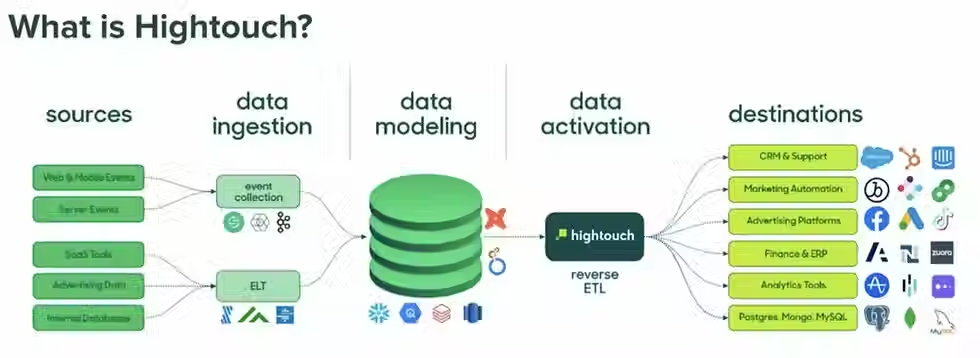
By the time the composable CDP movement arrived, the conclusion was obvious: if the warehouse already contains the canonical customer data, why replicate it inside a separate platform? In this model, the CDP becomes middleware rather than a destination.
Warehouse-native platforms like Hightouch position themselves as a thin orchestration layer sitting on top of the data warehouse. Customer data stays in the warehouse, while the CDP coordinates segmentation, activation, and increasingly agent-driven execution across downstream systems.
This model becomes particularly relevant in the AI era. If marketing agents can access governed customer data directly from the warehouse, they can begin planning campaigns, orchestrating messaging, and optimizing performance autonomously. The CDP’s role thus shifts from marketer interface to control plane for agents. In this future, the CDP does not disappear, but instead becomes both middleware and infrastructure.
2. The Intelligent Marketing Platform
A second group of vendors sees the future very differently. This is the Treasure Data and the AI-native CDP cohort. Rather than dissolving into infrastructure, this camp believes the CDP should evolve upward into an AI-native marketing platform. Treasure Data represents this view particularly well, and frankly it’s a strong argument that works well in a world where IT reasserts itself, which is a strong possibility for enterprise organizations, bucking the recent trend of marketing-based decisioning when it comes to anything first-party data.
Their thesis is that the complexity of the modern MarTech stack has reached a breaking point (hard to disagree), and organizations now operate dozens — sometimes hundreds — of tools, each responsible for a narrow slice of functionality — the downside of the composable model, I would argue. Instead of continuing to fragment the stack, this vision argues that AI must simplify it, which is certainly a primary goal of most IT departments I work with today.
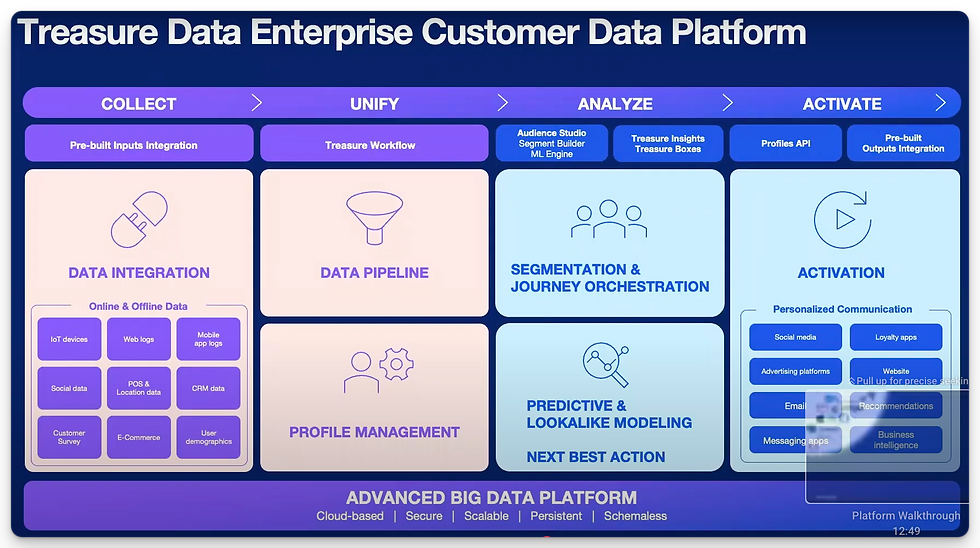
In this model, the CDP absorbs capabilities that were historically scattered across the stack: predictive modeling, decisioning, campaign orchestration, optimization, and measurement. AI becomes embedded directly into the platform’s operating layer.
The end result is something closer to a marketing operating system that an individual tool. Marketers still interact with a recognizable platform interface, but much of the underlying work — segmentation, experimentation, optimization — is increasingly automated and abstracted away.
This approach assumes that organizations want fewer tools, not more. And for many enterprises exhausted by a decade of MarTech sprawl, this argument is extremely compelling. Again, I would imagine that this model is probably most attractive to organizations that are particularly IT-driven, because it centers on simplifying the MarTech stack and brings many advanced capabilities under IT’s stewardship. Considering Treasure Data’s strong legacy in cloud data warehousing and successfully selling into IT organizations, this is not altogether surprising, and it aligns well to their strengths.
3. The Unified Experience Stack
Now let’s turn to the approach being pushed by Adobe and the big, monolithic platforms, which is more of an ecosystem bet, if you will. If the warehouse-native vision is built on decomposition, the Adobe worldview is built on the polar opposite assumption: AI rewards integration.
Adobe’s strategy centers on the belief that modern marketing cannot operate effectively if data, identity, consent, content, and experience delivery are fragmented across multiple systems. In the Adobe model, the CDP sits at the center of a tightly integrated ecosystem — Adobe Experience Platform and Real-time CDP beneath applications like Journey Optimizer, Target, Analytics, and Experience Manager.
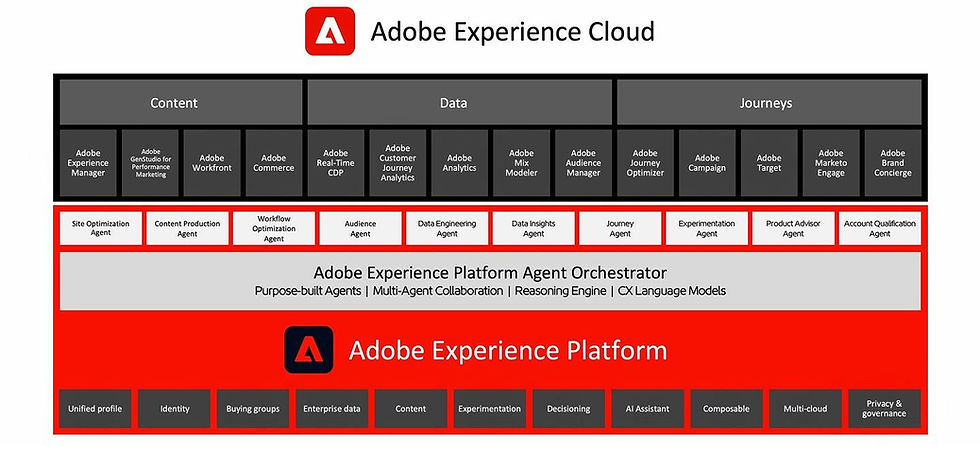
AI capabilities are embedded as features or enablers throughout this stack. Content generation, journey orchestration, and personalization are all powered by shared data models and governed identity frameworks. Rather than agents operating independently across tools, intelligence is embedded directly into platform workflows, abstracting away pivots between tools but leaving the underlying architecture largely intact.
Not surprisingly. this approach is particularly attractive to global enterprises with complex governance requirements. When compliance, brand safety, and operational consistency are paramount, the appeal of a tightly integrated ecosystem becomes obvious—maybe necessary.
Some critics often describe this as “platform lock-in,” while supporters would probably describe it as operational coherence. In a sense, both perspectives are true.
4. The AI-Ready Data Layer
Last, let’s turn to Tealium’s real-time intelligence model. This final cohort sits somewhere between these extremes, which is what will probably make it attractive for many organizations. Tealium’s vision reframes the CDP not as a monolithic platform or disappearing abstraction, but as the intelligence layer that prepares data for AI systems. In this model, the warehouse and the CDP serve complementary roles.
The warehouse provides long-term storage and historical context. The CDP, by contrast, provides real-time identity resolution, consent enforcement, and event processing—capabilities required for not only for immediate decisioning, but also to gather inputs for AI models marketers are increasingly being asked to build solutions on top of.
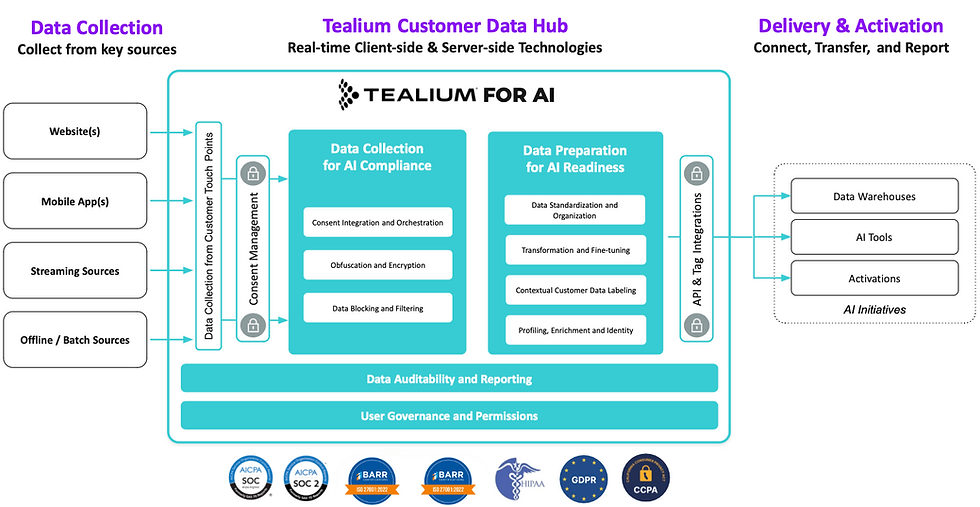
Part of this argument centers on the belief that as AI adoption accelerates, the quality and governance of data quickly become existential issues. This is because autonomous systems making decisions based on incomplete or non-compliant data create significant risk — and the need for high-quality, consented data at scale becomes paramount.
Tealium’s approach positions the CDP as the real-time data substrate that ensures AI systems operate on trusted, compliant information at scale. This approach may sound less glamorous than agent-driven marketing automation, but it may ultimately prove to be one of the more durable architectures in the ecosystems of tomorrow, balancing speed and scale with quality and compliance.
What These Models Reveal About the Market
Taken together, these four visions reveal something important about where the CDP market is actually headed. It is not converging toward a single architecture. If anything, it is moving in the opposite direction. As we discussed on the podcast episode, the category increasingly resembles “a meteor breaking apart in the atmosphere” — the idea of the CDP fragmenting into several different systems solving adjacent problems.
The fragmentation is happening along two fundamental axes. The first is platformization versus composability. Large enterprise ecosystems—Adobe, Salesforce, Oracle—are built on the assumption that AI will reinforce the value of tightly integrated platforms. In this worldview, customer data, consent, identity, content, and activation should live inside a governed environment where everything works together.

The composable camp starts from the opposite premise: the data warehouse has already become the system of record, and marketing systems should be modular layers sitting on top of it. As Niederberger put it during the conversation, the real advantage of a composable architecture is simple: you own the data, which means tools can change without forcing the entire stack to be replaced.
The second axis is human-driven workflows versus agent-driven execution. Some vendors believe AI will primarily enhance existing marketing processes, helping marketers analyze audiences, optimize campaigns, and generate content faster. Others are betting on something more radical: autonomous marketing agents capable of making thousands or even millions of micro-decisions in real time. In the podcast we referred to this as the “billion decision problem” — the idea that the volume and speed of optimization required in modern marketing is quickly exceeding what human teams can manage on their own.
Architecture and autonomy.
Those two debates are now quietly reshaping the CDP market — and they help explain why the category suddenly feels far less settled than it did just a few years ago.
The Most Likely Outcome
So which vision wins? Probably none of them — at least not in the way the industry likes to imagine. Technology markets almost never resolve into a single dominant architecture, no matter how many vendor decks or analyst reports suggest otherwise. What usually happens is both messier and more interesting: the market stratifies. Different models take hold in different environments, shaped by organizational structure, technical maturity, and the political realities inside large companies.
In all likelihood, platform ecosystems will continue to dominate parts of the enterprise where governance, compliance, and operational control outweigh everything else. If you are a global brand with complex regulatory requirements and dozens of markets to coordinate, the appeal of a tightly integrated platform like Adobe or Salesforce is obvious—especially if you already use Adobe Experience Manager for your dotcom or Salesforce as CRM.

At the same time, warehouse-native and composable architectures will continue to gain ground in organizations where engineering teams control the data layer and agility matters more than platform purity. These companies increasingly see the data warehouse — not the CDP — as the real system of record. I don’t see this trend reversing anytime soon.
Meanwhile, real-time intelligence layers will remain critical anywhere identity resolution, consent enforcement, and event processing need to happen in milliseconds. And increasingly, the decisioning layer on top of all of this will be handled by autonomous systems — agents optimizing campaigns, allocating budget, and making thousands of micro-decisions faster than any human team possibly could.
What almost certainly does not survive is the original promise of the CDP. For years the industry told itself a comforting story: that marketing would eventually own a single platform where all customer data lived, where segmentation happened, and where activation flowed outward to the rest of the stack.
That vision may have made sense in 2015, but the world that created it — a simpler MarTech stack, a slower pace of change, and a human-driven marketing workflow — no longer exists.
What to Watch Next
Over the next several years, three developments will do more than anything else to determine how this market evolves.
1. The rise of marketing agents. AI is rapidly moving beyond simple automation into systems capable of planning, executing, and optimizing marketing activity with minimal human involvement. We are already seeing early versions of this in campaign optimization, media bidding, content generation, and customer journey orchestration. As these capabilities mature, the most important question will no longer be which platform marketers log into every day. The real strategic battleground will be the control layer that feeds these agents clean, governed, real-time data. Whatever system sits between enterprise data and autonomous decision-making will become the most valuable piece of the stack.
The continued dominance of the data warehouse. Nearly every serious architectural conversation in MarTech now begins with the same question: where does the source-of-truth data actually live? Over the past decade, the answer has increasingly shifted toward cloud data platforms like Snowflake, Databricks, and BigQuery. As more companies centralize their data there, the role of traditional application-layer systems — including CDPs — inevitably changes. Given this evolution. some vendors will evolve into orchestration layers, while others will center on intelligence. But the gravitational center of the stack has already moved toward the warehouse, and it is unlikely to move back.
The fragmentation of the MarTech stack itself. For years, the industry talked breathlessly about “stack consolidation.” In practice, the opposite dynamic may now be unfolding. Micro-SaaS companies, composable architectures, and AI-generated applications are dramatically lowering the barrier to building specialized tools. Marketing teams can spin up narrowly focused capabilities — sometimes in weeks — that previously required a full platform purchase. The result is an explosion of niche solutions solving very specific problems extremely well.
Ironically, the very complexity the CDP category originally set out to solve may now be accelerating again. The difference this time is that the fragmentation is being driven not by vendor proliferation alone, but by the flexibility of modern infrastructure itself with the backdrop of AI disruption.
The Real Question
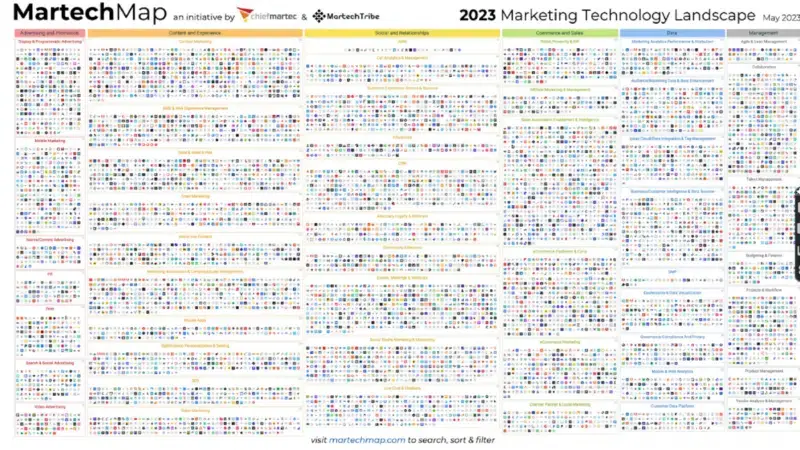
This leads us to the question the industry is quietly avoiding. The future of the CDP may not hinge on which vendor wins, but instead whether the category itself survives. Don’t get me wrong, I don’t believe CDPs are going to disappear, at least not overnight. But I do think the trends laid out in this articles point to a future in which there are probably several very different types of CDPs that eventually branch off and evolve independently, potentially becoming different tools on the MarTech Map
Ten years ago, the CDP emerged to solve a very real problem: marketers had no system of record for customer data, data lived in dozens of disconnected applications, IT controlled access, and marketers had no practical way to unify or activate their own customer intelligence. The CDP filled this gap. But the world that created that gap has changed irrevocably.
Today, the role of “customer system of record” is being aggressively contested. Cloud data warehouses have become the default home for enterprise data. Large platforms like Adobe and Salesforce are embedding identity and decisioning directly into their ecosystems. And a new generation of AI-driven orchestration layers is beginning to sit on top of everything, making decisions without needing a traditional application interface at all.
In other words, the original CDP problem has not disappeared — viewed by the number of ways to solve it, if anything it has exploded. This means the industry may be asking the wrong question. The debate should not be about which CDP vendor wins the next Magic Quadrant, but rather is the “CDP” category meaningful at all. The market is no longer converging on a single answer, which may be ultimately good for marketers.
Instead of doubling down on one model, it is experimenting with several. And that experiment is just getting started.
----------------------------

Rio is an executive with 20+ years at the intersection of strategy consulting, AdTech, data, and media. He's a trusted advisor on customer experience, digital strategy, and marketing transformation. He's a partner at Credera, Omnicom's consulting arm. He's also a podcast host, writer, and public speaker focused on the future of advertising and AI-driven infrastructure.


Comments