
We Passed the Turing Test and Went Back to Work

For most of the modern computing era, the Turing Test represented something akin to a mythical boundary. Proposed by English mathematician Alan Turing in 1950, the idea was remarkably simple: if a machine could carry on a conversation well enough that a human could no longer reliably distinguish it from another person, then perhaps we need to consider if the machine is actually able to think.
Since Turing introduced his test, it has been highly influential in the philosophy of artificial intelligence, and for decades, the threshold belonged mostly to science fiction and philosophy. Then, almost without ceremony, the Rubicon was crossed. In a 2025 controlled study, OpenAI's GPT-4.5 was judged to be the human participant 73 percent of the time when prompted to adopt a humanlike persona—more often, ironically, than the actual human it was being compared against.
And... it was almost as if nothing happened. There was no singularity or uncontrollable "intelligence explosion" where technological progress accelerates so fast human comprehension and control break down. Androids didn't suddenly awake and try to take over the world. There was no SkyNet, nor was there a collective moment when humanity stopped what it was doing and acknowledged that one of the great imagined thresholds of the machine age had been crossed. Instead, we opened ChatGPT the next morning and asked it to summarize a meeting, rewrite an email, analyze a spreadsheet, debug some code, or make a PowerPoint.
The more I think about it, the more I find this is profoundly strange. Maybe even absurd. For generations, we imagined the arrival of machine intelligence as a civilization-altering event. Open the pod bay doors, Hal? Yet when machines finally became capable of conversing with us in ways that Alan Turing could only dream about, we absorbed the capability into everyday life with astonishing speed and banality. What was once a philosophical thought experiment became another tab in the browser. One day we passed the Turing Test. We then woke up the next morning and went back to work.

Intelligence Arrived, but Life Didn't
Maybe part of the problem is that we spent the better part of the last century imagining artificial intelligence incorrectly. Think about it what we grew up with. Science fiction conditioned us to believe that AI would eventually arrive in the form of artificial life, like HAL 9000 from 2001: A Space Odyssey, or Data from Star Trek. Or maybe even the replicants in Blade Runner, or The Terminator and SkyNet. All of these machines, despite their often homicidal tendencies, seemed to possess something resembling a will of their own. They didn't simply answer questions, but had personalities, motivations, desires and, in some cases, something that looked suspiciously like what we deem consciousness.
That's not all all what has happened—at least not yet. What we have created instead is arguably much stranger: intelligence without life. As famous AI engineer Andrej Karpathy recently said, "Stated plainly, today's frontier LLM research is not about building animals. It is about summoning ghosts." In many ways, we have created intelligence that can imitate many of the outward signs of life—conversation, reasoning, creativity, even personality—without creating anything we would recognize as actually being alive.

Ghosts or spirits aside, the intelligence itself is both increasingly impressive and increasingly difficult to dismiss. Anthropic CEO Dario Amodei has famously described a near-future world containing a "country of geniuses in a datacenter," where millions of AI systems vastly more capable than today's best humans could operate simultaneously. Whether this exact vision arrives anytime soon is up for debate, but an early incarnation of his imagined future is already here. Anyone carrying a smartphone can now summon an AI capable of writing software, analyzing complex documents, translating languages, tutoring advanced mathematics, generating images, conducting research, debating philosophy or even explaining quantum mechanics. Much of what once required specialized human expertise can increasingly be accessed by typing a few sentences into a box.
Yet nobody could seriously mistake a chat box for being alive. ChatGPT doesn't wake up in the morning, Claude doesn't get bored, and Gemini certainly isn't worried about its career—or yours. These amazing tools don't appear to want anything from us, or from each other. Close the browser window and there isn't a sense that someone is sitting somewhere waiting for you to come back.
We imagined artificial intelligence would arrive as a creature. Instead, intelligence became a utility. Perhaps that is why something so extraordinary has begun to feel so ordinary and even mundane.
The Fastest Revolution That Somehow Feels Slow
This brings us to another strange paradox of the AI era. By almost any measure, artificial intelligence is advancing at an astonishing pace. According to the 2026 Stanford AI Index, generative AI reached 53 percent adoption within just three years—much faster than either the personal computer or the internet. What's more, 88 percent of organizations now report using AI in some capacity, and 70 percent are using generative AI in at least one business function. Looking at technical benchmarks, the frontier keeps moving so quickly that some tests designed to challenge AI models for years are becoming obsolete within months.
Yet step outside and the world still looks remarkably similar to the one we inhabited before ChatGPT arrived. People still mostly commute to offices. Companies still have org charts, budgets, bosses and death-by-meetings. Despite prognostications of mass layoffs and doom, most of the occupations that existed in 2022 still exist today. Schools still have teachers standing in front of classrooms, doctors still see patients, and lawyers still argue cases in court. And despite all the breathless talk about autonomous AI agents running businesses and replacing entire departments, Stanford found that actual AI agent deployment remains in the single digits across nearly every business function in existence.
This isn't to suggest that nothing has changed. To the contrary. I use AI constantly, and it has fundamentally altered how I work. Millions of people can probably say the same thing. Software developers write code using Claude or Cursor, marketers pump out content with ChapGPT, and researchers find information using Gemini. Students already learn differently. Entire categories of tasks that once took hours can now be accomplished in mere minutes. I'm not arguing these are insignificant changes. But they also aren't the wholesale reinvention of society many of us expected when ChatGPT first appeared.
Perhaps the strangest part is how much of this revolutionary technology is still being squeezed into old patterns of human behavior. We have access to something resembling a universal intelligence machine, or a datacenter full of geniuses, and most of us interact with it by typing sentences into a rectangular box—the same basic interface humans have been using to communicate with computers for decades. The technology is moving unbelievably fast, but the world around it isn't. Maybe that's not a contradiction at all, but it is interesting to consider.

Technology Moves Fast, but Society Doesn't
A look back at history suggests there shouldn't be anything particularly surprising about this phenomenon. Generally speaking, we have a tendency to imagine technological revolutions taking place the moment a breakthrough occurs: James Watt and the steam engine, Thomas Edison and the lightbulb, the first personal computer, the birth of the World Wide Web, etc. But even recent history instructs inventions don't transform society when they are invented. Instead, they truly ansform society when everything around them finally begins to change, a process that spans decades, not years.
Electricity is a great example. Electric motors existed by the late 19th century, but factories couldn't simply replace their steam engines with electric motors and suddenly become modern factories. It couldn't work that way because the entire factory had been designed around steam power, with giant central engines driving elaborate systems of shafts, belts and pulleys. To capture the real benefits of electricity, manufacturers eventually had to rethink and redesign the factory itself. This meant changing where machines were located on the factory floor, how production lines worked, how workers moved through buildings, and even where factories were built in the first place, moving to urban centers from the countryside. The entire reinvention process must have taken decades.
Computers followed a remarkably similar pattern. By the 1980s, businesses were spending enormous amounts of money on information technology, yet the promised productivity boom was nowhere to be found. Economist Robert Solow famously joked in 1987 that, "You can see the computer age everywhere but in the productivity statistics." This phenomenon became known as the "productivity paradox." Computers were getting dramatically better, and cheaper, but organizations hadn't yet figured out how to redesign themselves around them. Again, the process took several decades to complete.
The internet may be an even more familiar example to many readers. I had a Commodore 64 that I learned how to program on at home in the 80s, but I first started using a machine connected to the Internet for work in the mid-1990s, and it was immediately obvious to me at the time that something extraordinary had arrived. But alas the world didn't suddenly become digital in 1995. It took decades of broadband deployment, smartphones, cloud computing, ecommerce adoption, social networks, streaming media, new business models, and eventually a global pandemic before the internet became completely intertwined with almost every aspect of modern life.
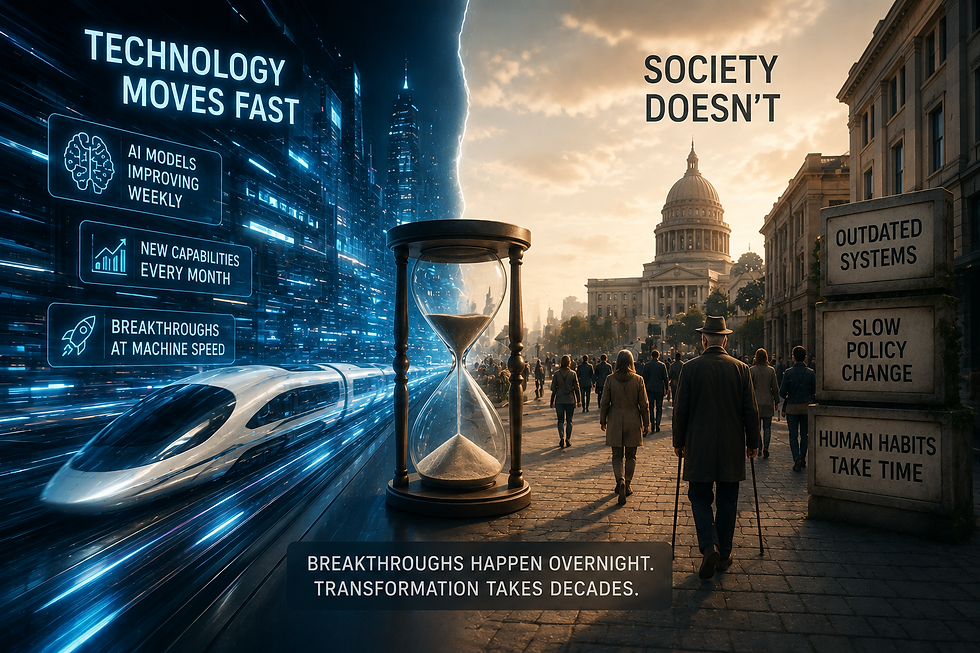
It's likely AI will follow the same pattern. Economists Erik Brynjolfsson, Daniel Rock and Chad Syverson actually predicted something very similar years before ChatGPT arrived. In a 2017 paper on the "modern productivity paradox," they argued that technologies like AI often require waves of complementary innovations before their full economic effects become tangible. In other words, new processes need to be invented, workers need to retrain or learn new skills, and organizations need to change. Above all, business models themselves need to evolve, and entire systems built around the previous technology need to be dismantled and reconstructed. Sound familiar?
This is the part we tend to underestimate. Sure, OpenAI can drop a dramatically more capable model overnight, and Anthropic can improve Claude in a matter of weeks. But a Fortune 500 company can't redesign 50,000 jobs overnight. Nor can a school system rewrite its curriculum in a semester. And there is no way in hell governments can't instantly rewrite laws and regulations. Looking at society itself, tens of millions of people can't simply abandon habits, skills and ways of working they've developed and internalized over decades. The technology may move at the speed of silicon, but society still moves at the speed of humans.
So Where Are All the Missing Jobs?
Nowhere has the disconnect between the speed of AI and the speed of society been more apparent than in the labor market. Since ChatGPT arrived, we've been inundated with dire predictions of an impending "jobs apocalypse." Depending on who you listen to, AI is going to eliminate half of all entry-level white-collar jobs, wipe out entire professions, make software developers obsolete, or eventually leave most humans with very little economically useful work to do. Four years into the experiment, that simply hasn't happened. Not by a long shot.
Sure, you can argue there are some warning signs. According to the 2026 Stanford AI Index, employment among software developers between the ages of 22 and 25 has fallen nearly 20 percent since 2024. Looking more broadly, employment among workers in that same age group in the occupations most exposed to AI has declined roughly 16 percent relative to the least-exposed occupations. It seems increasingly plausible that AI is already beginning to disrupt the bottom rungs of certain career ladders—this doesn't seem like a stretch to me.
But zoom out, the picture looks remarkably different, and better. A 2026 study using U.S. Census Bureau data found that just two percent of firms using AI reported employment reductions associated with it. In fact, 66 percent of firms using AI report using it exclusively to augment human tasks rather than replace them altogether. Another recent study of nearly 6,000 senior executives across the US, UK, Germany, and Australia found that more than 90 percent reported no employment impact from AI over the previous three years.

This doesn't mean the predictions about AI and employment are going to be wrong in the long-run. But "in the long run we are all dead," as economist Keynes said in his 1923 book, "A Tract on Monetary Reform." Truth be told, we may simply be in the early innings of this transition. What's more, we may need to reassess what actually constitutes a job if we are going to talk about job replacement. A job, after all, isn't a task, which we know AI excels at doing. In fact, most jobs are complicated bundles of dozens or even hundreds of tasks, jumbled together with judgment, accountability, relationships, institutional knowledge, politics and occasionally knowing which person to call when something goes wrong.
What I already see happening is AI automating a large number—let's say 30 percent of the things (tasks) someone does—without eliminating that person's job itself. What this means of course is the person's job changes, but is not eliminated. Over time, perhaps the company eventually needs fewer people in this role. Maybe entry-level hiring slows. Or maybe entirely new responsibilities or categories of work emerge. But all of this takes time to shake out.
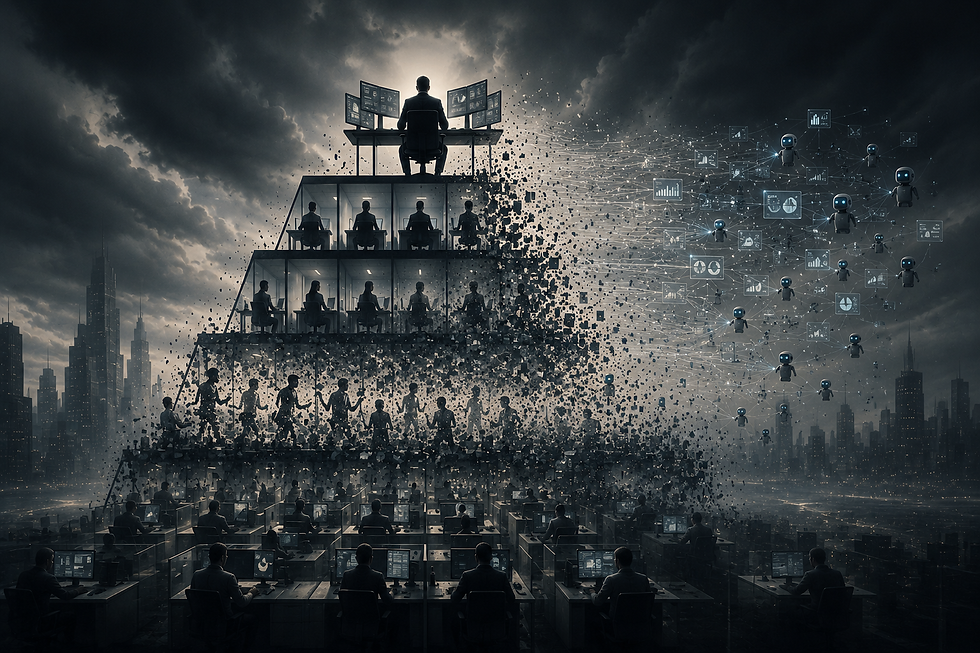
I think this is the process we're witnessing right now. AI isn't necessarily eliminating occupations so much as quietly hollowing out, reshaping and recombining the tasks inside them. The jobs apocalypse hasn't arrived, but the architecture of work may already be shifting underneath our feet.
Maybe It's Just Early
Looking through a historical lens, it's likely the biggest mistake we've made in thinking about the AI revolution is related to time. Let's be honest, we're most likely just a few years into what could easily be a 20- or 30-year transformation, and we're already asking why the world hasn't completely changed yet. Maybe the better question is: What did we expect?
Think about the internet again. In 1998, the internet was unquestionably revolutionary. Amazon was already there, Google had just been founded, and millions of people were going online. The direction of travel was already obvious to anyone paying attention. Yet if you had frozen the world at that moment and tried to judge the ultimate impact of the internet, you would have missed almost everything that ultimately mattered.
At the time, there was no iPhone, Facebook, YouTube, Netflix streaming, Uber, Airbnb, Spotify, Instagram, TikTok or cloud hosting/computing as we understand it today. Ecommerce represented a rounding error (around 0.2 percent) in overall retail sales. What's more, newspapers were—believe it or not—still enormously profitable businesses. Cable television was booming, and most people still bought music on CDs, rented movies from physical stores like Blockbuster, and booked airline tickets through travel agents. Sure, the internet had arrived, but the civilization that would eventually be built around it had barely begun to take shape in any meaningful way.

Maybe 2026 is really AI's version of 1998. Think about it. The foundational technology is here, the intelligence is real, and hundreds of millions of people are already using it. The systems themselves are improving at a rate that remains difficult to comprehend. But let's face it, we're still figuring out what to build with them. Companies are bolting AI onto workflows designed before AI existed. Schools are debating whether students should be allowed to use it, and governments are debating how to regulate it. Looking at SaaS, most companies still treat AI as a feature or layer to be slapped on top of existing databsed and workflows, rather than the organizing principle around which the product itself is designed—what we call AI-native in tech parlance.
This is why I'm increasingly skeptical of both extremes in the AI debate. The skeptics look at the world today, see that it hasn't been transformed, and conclude that AI was overhyped, and of course predict an inevitable AI crash reminiscant of the dotcom bust. The accelerationists, on the other hand, look at the capabilities of the newest models and assume society will transform at roughly the same speed.
History suggests both are wrong.
I believe the AI revolution will turn out to be every bit as consequential as its most enthusiastic advocates believe. But I think it might take decades rather than years for us to fully understand what we've created—and rebuild the world around it.
The Revolution Will Move at Human Speed
Maybe the concept of "human speed" is the perspective we're missing as we approach the fourth anniversary of the AI era. I find this ironic because while we spend so much time measuring how quickly the machines are improving, we forget to assess how quickly the world around them is actually capable of changing. The difference between those two speeds is enormous.
An AI model can improve dramatically between a couple releases. But a large company simply can't reorganize itself overnight. Try as it may, a university can't redesign its curriculum in a semester, and there's no way in hell governments can rewrite laws at anything approaching the speed of technological progress. Moreover, billions of humans can't suddenly abandon habits, changing ways of working that have accumulated over decades or even generations.
None of this means the AI revolution isn't happening. I believe it is. Nor does it mean that AGI, superintelligence, autonomous agents, humanoid robots, or something even stranger isn't lurking somewhere in our near future. Maybe they are. But bold and unserious predictions have distracted us from something extraordinary that has already happened.
We passed the Turing Test! We created intelligence without creating life! We put something resembling a datacenter full of geniuses into everyone's pocket. And then, remarkably, we pretty much just carried on with our lives as if nothing happened—for now, at least.
Intelligence arrived faster than almost anyone expected, but the revolution will take much longer. Not because the machines are moving slowly. Because we are.
------------------------------------------------

Rio is an executive with 20+ years at the intersection of strategy consulting, AdTech, data, and media. He's a trusted advisor on customer experience, digital strategy, and marketing transformation. He's a partner at Credera, Omnicom's consulting arm. He's also a podcast host, writer, and public speaker focused on the future of advertising and AI-driven infrastructure.


Comments