
Go Where You Know. But Learn to Earn It.

Comfort Is a Floor, Not a Ceiling
My son has been knocked flat by the same wave four times in a row. Each time, he pops back up laughing, wipes the sand from his face, and sprints right back into the ocean. No adjustment to the strategy. No concern for what just happened, just the conviction that the next wave might be even better.
I respect the commitment. My wife watches him charge back into the surf and turns to me and says,
“Why didn’t we do this before?” To frame the situation, we’re in the Dominican Republic for the first time. Just the three of us with o extended family. We purposfully don't have a packed itinerary, and there are no traditions to maintain. This is a trip we almost didn’t take because we already had a perfectly good version of this kind of vacation.
And yet, without question, it’s become the best family trip we’ve ever taken. The funny thing is, we’ve said that before. Five years ago, sitting on the last night of our honeymoon in Turks and Caicos, we looked at each other and said, We need to come back here every year. We meant it—it was incredible.
But we never went back.
What happened? Life happened. Schedules filled up, priorities shifted, and eventually, without even trying, we found something we liked even more. This seems to be the pattern: We discover something that works—a destination, a habit, a process, a set of tools—and quietly promote it from this is great to this is the best. Not because we’ve carefully evaluated every alternative, but because we don’t yet have the reference points to know what else might be out there.
On some kind of way, comfort is a floor. We spend a surprising amount of time treating it like a ceiling.
I’ve been thinking about that distinction a lot lately. I build things now—AI products, consulting systems, software for families and small businesses, and occasionally all three in the same week, which is apparently a lifestyle choice I’ve made for myself. Over time, I’ve settled into tools and workflows that I genuinely enjoy using. My development environment, the orchestration layer that helps run my consulting business.
These patterns have become second nature. They work, and because they work, I mostly leave them alone. But sitting here in the Dominican Republic watching my son run headlong into the ocean with absolutely no regard for consequences, I keep thinking about the version of me that almost said, Let’s just do what we always do. What would I have missed?
When Choices Become Defaults
There’s a cost to familiarity that people don’t talk about very often. Not the obvious cost—the feeling of being stuck in a rut—but something subtler. Over time, the things we once chose intentionally stop feeling like choices at all. They become defaults, and eventually, we stop evaluating whether they’ve earned the right to remain our defaults. This distinction matters because familiarity can come from confidence, or it can come from habit or inertia. From the outside, those two things look almost identical, but there are not the same.
I was reminded of that when I left Snowflake and suddenly found myself with a blank slate.
There was no inherited tech stack, or engineering leader explaining how things were done. I had no organizational muscle memory to lean on. For the first time in years, I could build however I wanted.
And what did I reach for? Ironically but not surprisingly, everything I already knew.
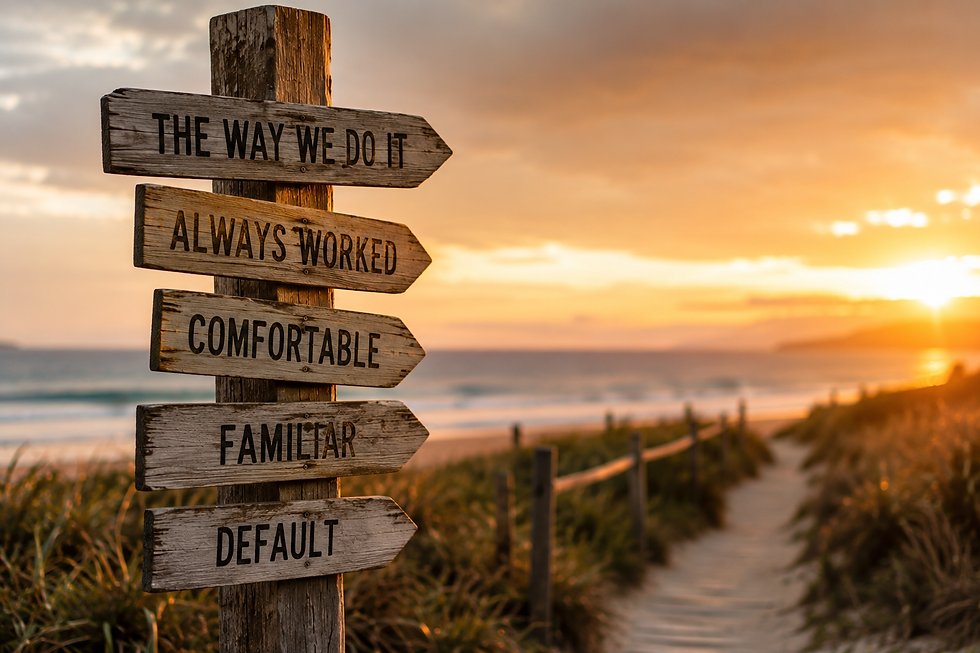
Every workflow, every development pattern, every tool that had been reinforced over years working inside larger organizations. Not because I’d recently evaluated them or they were the right things per se, but because they were familiar. They were loaded and ready, like muscle memory pretending to be a decision. It wasn’t until I forced myself to spend meaningful time with AI-assisted development—long enough to get past the initial discomfort and the inevitable “this feels weird” stage—that I realized how much had changed.
As I went through this process, some of my old assumptions still held up, while others didn’t. But I wouldn’t have known the difference without running the experiment. That’s the thing about defaults. They often feel like choices when they’re really just the last choices we remember making. What I think it comes down to is the evaluation itself is the skill—the part I think matters most. And this is true whether you’re building a company, navigating a career, or simply trying to keep pace with a world that seems to reinvent itself every quarter.
Earned Confidence Beats Comfortable Ground
End of the day, consistency itself has value, and so does depth, but when it comes down to getting things done, mastering a small number of things is usually better than being mediocre at dozens.
But mastery and stagnation can look remarkably similar from the outside. Ultimately, the difference is whether you chose to stay, or simply never left.
People who periodically test their assumptions—and then consciously decide to keep doing what they’ve always done—operate with a different kind of confidence. Their defaults have earned their position, but they not only know why these default are there, but can defend them. When something genuinely better comes along, they’re more likely to recognize it.
People who never revisit those decisions are standing on comfortable ground, but they don’t actually know how solid it is. Of course, there’s a trap on the other side too. I know people who chase every new framework, every new model, every new productivity tool. They’re constantly learning and constantly restarting. This means their systems are always changing, which means they’re never around long enough to compound.
What's the lesson here? Novelty isn’t the goal. Knowledge is. This means you should try new things with intention. Ask real questions like, "Is this actually better than what I’m doing today?" Spend enough time with it to move past the learning curve and into an honest evaluation. Then make a decision.
Go back to what you know if it wins, but go back knowing it won. This is what I mean by "learning to earn it."
Out vacation is winding down, and we’re heading home in a few days, and yes, we’ve already said,
“We need to do this again.” Of course we mean it—we really do But I also know that five years from now, we might find ourselves somewhere completely different, saying exactly the same thing.
This is not a contradiction. It's actually growth. You'd be crazy to abandon what works. But you need to keep earning the right to believe that it still does.

And every time you run that test, you gain something people who never do don’t have: knowledge.
Real knowledge—the kind that compounds. The Dominican Republic is the best family trip we’ve ever taken...At least until the next one.
-------------------------------------

Mike Vicenzino is a builder, consultant, and entrepreneur focused on the practical application of AI. He develops products, systems, and software that help families, small businesses, and operators navigate an increasingly intelligent world. He writes about technology, work, and the habits we carry forward—and the ones we should reconsider.


Comments